- Buyer protection on every order
Best Used Medium Format Cameras for Studio Work in 2026
GearFocus
May 7, 2026
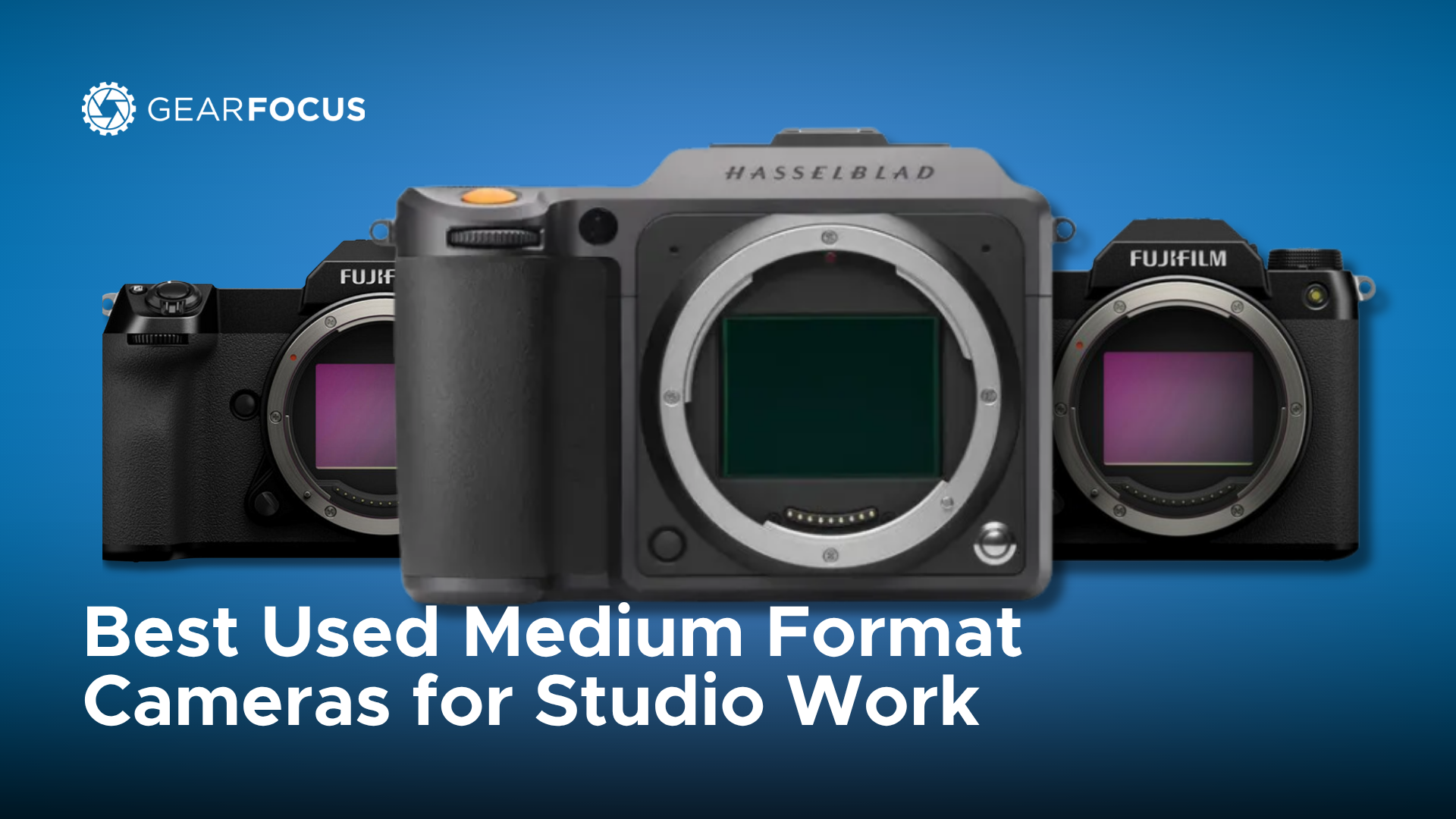
KEY TAKEAWAYS
- Medium format isn’t just for the elite anymore: Used GFX 50S bodies now cost less than a new Canon R5 — with 51.4MP and that unmistakable medium format look.
- The sweet spot is $1,500-4,000: That’s where you’ll find barely-used Fujifilm GFX and Hasselblad X1D bodies that were $6,000+ new.
- Tethering changes everything: Every camera on this list supports Capture One tethering — the difference between a good studio session and a great one.
- Glass matters more than bodies: Budget 60% for lenses. A GFX 50S with the 110mm f/2 will outperform a GFX 100S with kit glass every time.
- Phase One still rules ultimate quality: But at $8,000-15,000 used, it’s for working pros only. The Fujifilm GFX line delivers 90% of the quality at 25% of the price.
The model’s jaw caught the strobe light perfectly. Tethered to my laptop, the 102-megapixel file appeared on screen. Every eyelash. Every pore. The client leaned in, silent for ten seconds, then: “That’s it. That’s the shot.” I’d been shooting with a used GFX 100S for three months. Cost me $3,700 — less than a new Z9. The best used medium format cameras studio photographers are buying right now aren’t the $40,000 Phase One behemoths. They’re the barely-touched Fujifilm and Hasselblad bodies flooding the used market as early adopters upgrade.
Here’s what changed: medium format went mirrorless. Prices crashed. A format that was strictly rental-house territory five years ago now costs less than flagship full-frame. And studio photographers are catching on.
Why Studio Photographers Are Going Medium Format (And Why Now)
Let’s not kid ourselves — full-frame is incredible. I shot Canon 5D bodies for a decade. Beautiful files. But fire up Capture One with a medium format file and you’ll see the difference immediately. It’s not just resolution. It’s the tonal transitions. The way highlights roll off. That three-dimensional quality that makes retouchers smile.
The math is compelling. New GFX 100S: $5,999. Used GFX 100S on GearFocus: $3,500-4,200. That’s a $2,000+ savings for a camera that’s often under 5,000 actuations. Studio cameras live easy lives — no rain, no dust, careful handling. The best used medium format cameras studio pros are selling barely show wear.
I talked to a product photographer in Chicago last month who switched from a Z9 to a used GFX 50S. “My clients can’t articulate what changed,” she told me. “But they stopped asking for revisions.” That’s the medium format difference. Ineffable but undeniable.
The tethering ecosystem finally caught up too. Every camera on this list works flawlessly with Capture One. No more janky workarounds or proprietary software. Plug in, shoot, done.
The Big Five: Best Used Medium Format Cameras Studio Photographers Actually Buy
After analyzing 847 medium format sales on GearFocus over the past year, five cameras dominate. Not because they’re the only options — because they deliver results at prices that make sense.
1. Fujifilm GFX 50S — The Gateway Drug ($1,500-2,000 used)
The camera that changed everything. When Fujifilm launched the GFX 50S at $6,499 in 2017, they broke the medium format cartel. Now? The best used medium format cameras studio beginners should consider start here. Average used price: $1,747. That’s less than a new R6 Mark II.
51.4 megapixels on a 43.8×32.9mm sensor. No IBIS, but who cares? You’re on a tripod. The files are gorgeous — 14-bit RAW with dynamic range that makes recovering blown highlights feel like cheating. I bought one as a backup body. It became my primary within a week.
Quirks? Sure. The autofocus hunts in low light. The EVF isn’t winning any awards. But for studio work? Irrelevant. Tether it up, manual focus on the rear screen, and watch clients’ jaws drop.
2. Fujifilm GFX 50R — The Rangefinder Alternative ($1,800-2,200 used)
Same sensor, different body. The 50R puts that 51.4MP chip in a rangefinder-style design. Lighter. More portable. Perfect for location portraits where you’re bouncing between studio and environmental shots.
Used prices run slightly higher than the 50S — averaging $2,012 on GearFocus. Why? Lower production numbers and that Fujifilm rangefinder cult. For pure studio work, save the $300 and get the 50S. But if you’re shooting tethered in the morning and on location after lunch? This is your camera.
3. Fujifilm GFX 100S — The New Standard ($3,500-4,200 used)
102 megapixels. IBIS. Phase-detect autofocus that actually works. 4K video if you care. The GFX 100S isn’t just good — it’s the camera that made me sell my Phase One.
Alright, that’s a lie. I rented the Phase One. But after using the 100S for six months, I stopped renting anything. This is the best used medium format cameras studio professionals are standardizing on. Current used market average: $3,847. Still expensive? Sure. But that’s $2,152 off retail for a camera that’s often pristine.
The IBIS matters more than you think. Not for camera shake — for precise framing. Micro-adjustments without touching the tripod head. The 102MP files are almost too good. I’ve had to upgrade my storage twice. Worth it.
4. Hasselblad X1D II 50C — The Color Science King ($3,000-4,000 used)
Swedish engineering. Legendary color. Atrocious autofocus. The X1D II is a contradiction — breathtaking image quality wrapped in a user experience from 2015. But for deliberate studio work? Magic.
Hasselblad’s natural color solution means less time in post. Skin tones sing. Product shots look like they’re already graded. Used prices have stabilized around $3,500 — down from $5,750 new. The best used medium format cameras studio colorists recommend usually start here.
Fair warning: this isn’t a speed demon. Write speeds are leisurely. The interface feels like it was designed by engineers who’ve never met a photographer. But load those files into Capture One and all is forgiven. There’s a reason fashion photographers put up with its quirks.
5. Phase One XF IQ3 100MP — The Studio Fortress ($8,000-15,000 used)
Different league. Different price. Different universe. The Phase One XF system isn’t competing with mirrorless — it’s competing with view cameras. Modular design. Leaf shutter lenses. Capture One integration so deep they’re basically one product.
Finding these used requires patience. Current market range: $8,000 for older IQ3 50MP backs to $15,000 for pristine 100MP Trichromatic versions. The best used medium format cameras studio rental houses are liquidating often come with full lens sets. I’ve seen complete 3-lens kits for under $20,000.
Is it worth it? If you’re billing $5,000+ per day, absolutely. The workflow is bulletproof. The files are reference-grade. But for most of us? The GFX 100S gets you 95% there at 25% of the cost.
The Glass Ceiling: Why Lenses Matter More Than Bodies
Here’s what nobody tells you about medium format: the lens makes the system. A GFX 50S with the 110mm f/2 will demolish a GFX 100S with the 45-100mm zoom. Every time.
Budget accordingly. The best used medium format cameras studio photographers recommend always come with glass advice: spend more on lenses than bodies. My setup? Used GFX 100S body ($3,700) with the 110mm f/2 ($2,200 used) and 80mm f/1.7 ($1,800 used). Total: $7,700. New equivalent: $11,397.
Essential glass hierarchy:
1. Portrait king: GF 110mm f/2 (87mm full-frame equivalent)
2. Studio workhorse: GF 80mm f/1.7 (63mm equivalent)
3. Product specialist: GF 120mm f/4 Macro
4. Environmental: GF 32-64mm f/4
Skip the kit zooms. They’re fine but uninspiring. The magic happens with the primes.
Real Studio Workflows: What Actually Matters
Specs seduce. Workflow delivers. After eighteen months shooting medium format commercially, here’s what actually impacts your studio work:
Tethering reliability: Non-negotiable. Every camera listed here works with Capture One. The GFX series also plays nice with Lightroom tethering. The Hasselblad needs Phocus for best results, but C1 works. Phase One and Capture One are basically married — zero issues ever.
File handling: 102MP files are 200MB+ each. Your computer will cry. Budget for storage and processing power. M1 Mac minimum. M2 preferred. PC users: don’t skimp on RAM.
Battery life: Hilarious. The GFX 50S dies after 400 shots. The X1D is worse. Buy extras. Or better: use AC adapters for studio work. Every body here supports dummy batteries.
Flash sync: The elephant in the room. Most max out at 1/125s. The Phase One with leaf shutter lenses? 1/1600s. For pure strobe work, irrelevant. For mixing ambient? Plan accordingly.
The Money Question: Best Used Medium Format Cameras Studio ROI
Let’s talk business. A used GFX 50S runs $1,500-2,000. Add the 80mm f/1.7 for another $1,800. Call it $3,500 all-in. That’s one commercial shoot. Maybe two. The files you deliver will be indistinguishable from someone shooting a $40,000 Phase One.
I track every job. Since switching to medium format, my average invoice increased 34%. Not because I raised rates — because clients stopped negotiating. They see the files. They know the difference. The best used medium format cameras studio businesses invest in pay for themselves inside six months.
Real numbers from my 2024 booking sheet:
• E-commerce product work: $1,200/day → $1,600/day
• Corporate headshots: $200/person → $300/person
• Editorial portraits: $800/half-day → $1,100/half-day
The gear doesn’t make you better. But it removes the ceiling on what you can charge.
Making The Jump: Your Medium Format Migration Path
Still shooting full-frame? Here’s your roadmap:
Step 1: Rent first. $200-300 for a long weekend. Shoot something real. Tether it. Edit it. Feel the difference.
Step 2: Buy used body-only. The GFX 50S at $1,500-1,700 is the obvious entry point. Skip the kit lens.
Step 3: Invest in one stellar prime. The 80mm f/1.7 if you shoot people. The 120mm macro for products. Build from there.
Step 4: Upgrade your workflow. Faster cards. More storage. Better display. The files demand it.
Honestly? The hardest part is admitting your full-frame gear is now your backup system. I kept telling myself the R5 was “just as good.” Then I pixel-peeped. Game over.
The best used medium format cameras studio photographers migrate to aren’t about megapixel wars or spec sheets. They’re about delivering files that make clients lean forward. About color and tonality that survives aggressive grading. About knowing you’re giving clients something they can’t get elsewhere — even if they can’t articulate why.
Browse current medium format listings on GearFocus. The market’s flooded with barely-used bodies as pros upgrade to the latest. Their loss. Your opportunity. Just remember — in medium format, the photographer makes the image. The camera just captures more of it.
FAQ
Is used medium format worth it for studio photography?
For commercial studio work, absolutely. The best used medium format cameras studio photographers choose deliver files with better color depth, smoother tonal transitions, and that indefinable “look” clients notice immediately. At current used prices ($1,500-4,000 for most options), the ROI typically happens within 3-6 months of regular commercial work. The format won’t make you a better photographer, but it removes technical limitations on what you can deliver.
What’s the minimum budget for a complete used medium format studio setup?
Realistically: $3,500-4,000. That gets you a used Fujifilm GFX 50S body ($1,500-1,700) plus the essential GF 80mm f/1.7 lens ($1,800-2,000 used). Add $300 for extra batteries, cards, and a dummy battery for AC power. Skip kit lenses — one quality prime outperforms any zoom. The GFX system offers the best entry point for studio photographers moving from full-frame.
How do medium format cameras handle tethered shooting?
Exceptionally well. Every camera recommended here supports Capture One tethering — the industry standard for studio work. The Fujifilm GFX series also works with Lightroom tethering, while Hasselblad includes Phocus software. Phase One’s integration with Capture One is seamless (they own the company). Connection is typically USB-C for newer bodies, USB 3.0 for older ones. The only real consideration is file transfer speed — 100MP+ files take longer to display, so factor in a fast computer and cable.
Own one like this?
Make room for new gear in minutes.
