- Buyer protection on every order
Fireworks Photography 101: 10 Tips to Make Your 4th of July Shots Sparkle
Ysa Canlas
Jul 3, 2026
KEY TAKEAWAYS
- Manual mode is non-negotiable. Auto settings can’t react fast enough to fireworks in the dark — shutter speed, aperture, and ISO all need to be set by hand.
- Long exposure is the core technique. A 3–8 second exposure at f/8–f/11, ISO 100–200, is the baseline that produces sharp, glowing trails instead of blown-out streaks.
- Stability beats gear. A tripod, or any improvised stable base, matters more than camera price. Long exposures amplify every shake.
- Shoot RAW. JPEG compression discards the dynamic range needed to recover blown highlights and lift dark foregrounds after the fact.
- You don’t need new gear. A well-maintained secondhand body from a verified seller performs identically to retail for this kind of shooting.
Most people who come away disappointed from a fireworks show weren’t shooting with bad gear. They were shooting on auto, handheld, with autofocus hunting in the dark. Fireworks photography isn’t a gear problem — it’s a settings and preparation problem, and it’s fixable in the ten minutes before the first burst.
Below is the full breakdown: the settings, the stability tricks, and the gear that actually moves the needle — plus what to check if you’re buying a camera specifically for this kind of shooting.
1. Set Everything Manually
Auto mode has no idea what to do with fireworks. They’re bright, fast, and unpredictable, and your camera’s automatic settings will consistently misjudge exposure in the dark. Switch to manual and set shutter speed, aperture, and ISO yourself.
- Shutter speed: 3 to 8 seconds — this is what produces the glowing trails.
- ISO: 100 or 200 to keep noise low.
- Aperture: f/8 to f/11 for shots that stay sharp without losing depth.
A smartphone manual app can approximate this technique, but sensor limitations show — noise climbs fast in low light, and you lose the dynamic range that makes RAW editing viable. A used mirrorless body for under $400 outperforms any current phone for night shooting and long exposure work, which is why this is one of the most practical reasons to pick up secondhand gear.
Gear Tip: A used camera with reliable manual controls — a Canon M50 or Sony a6000, for example — is enough to shoot this well. Buying secondhand from a verified seller means you’re not paying full retail to learn a technique you’ll only use a few nights a year.
2. Stabilize the Shot
Long exposures amplify every tiny shake, so stability isn’t optional. A tripod is the most reliable way to guarantee sharp results — a budget tripod and a Manfrotto will both work as long as they’re sturdy. No tripod? A camera braced on a picnic table with a folded jacket underneath, or set on top of a cooler, holds steady enough in a pinch.
If you’re buying gear specifically for this, a flexible GorillaPod or a compact tripod head is a practical, portable option. One detail worth knowing: if your tripod has a hook, hang your camera bag from it — the added weight helps in windy conditions.
3. Dial In Settings as the Show Goes
There’s no universal setting that works for every show — lighting, distance, and firework type all change the equation. Start with a baseline of ISO 100, f/8, and a 4-second shutter speed, then check your first few frames.
- Too bright? Shorten the exposure to 2 or 3 seconds.
- Too dark? Stretch it to 6 seconds, or bump the ISO to 200.
Photographers who lock in one setting and never adjust tend to walk away with a memory card full of overexposed frames. Check your LCD after each burst and adjust — the show’s rhythm changes, and your settings should too.
4. Shoot RAW, Not JPEG
JPEG compression discards the dynamic range fireworks demand — you lose vivid color and the subtle detail in dark foregrounds. RAW files let you recover blown-out highlights, lift shadows, and correct white balance after the fact without the image degrading.
A RAW file is effectively a second chance at the shot in Lightroom or Capture One — recovering an overexposed burst or brightening a silhouette that came out too dark. If you’re new to editing, start with small adjustments; even minor corrections can turn a flat frame into a usable one.
5. Use Long Exposure Deliberately
Long exposure is the technique that makes fireworks photography work — keeping the shutter open long enough to trace the fireworks’ path across the sky instead of freezing a single spark.
- Most bursts: 3 to 5 seconds.
- Rapid-fire finales: 1 to 2 seconds, to avoid a blurred wash of light.
- Dark, rural settings: up to 8 or 10 seconds for dramatic trails.
- Cities with ambient light: shorter exposures to avoid overexposing the frame.
Shooting over water is one of the best ways to put this to use — a 6-second exposure over a lake can capture both the burst and its reflection in the same frame.
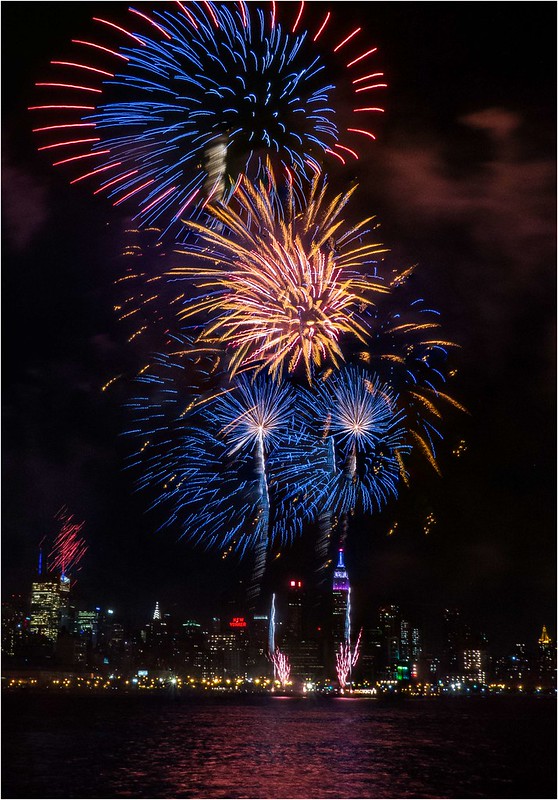
both the burst and its skyline reflection in a single frame.
6. What Lens to Use
Focal length shapes the shot more than most guides acknowledge. Wide-angle (16–35mm) captures the full arc of a burst plus foreground context — skyline, crowd, water. A standard zoom (24–70mm) gives you the most flexibility to reframe without swapping glass mid-show. Telephoto (70–200mm) isolates individual bursts for abstract, detail-heavy compositions, but requires tighter timing and more precise framing.
For most shooters, a 24–70mm or a wide prime (24mm or 35mm) covers 90% of what you’ll want. Fast aperture doesn’t matter here — you’re shooting at f/8 to f/11 anyway, so an f/1.4 lens has no advantage over an f/4. That makes used lenses in this range significantly cheaper than most people expect.
Buying gear for this? Every camera and lens on GearFocus comes from a verified seller, backed by our buyer protection policy. Browse the marketplace →
7. Compose for Context, Not Just the Sky
The strongest fireworks shots include more than the explosion — a crowd, a skyline, or a reflection on water gives the frame context. Silhouettes of people watching add scale and emotion that a bare burst of light can’t. A landmark or Ferris wheel in the foreground turns a generic frame into a specific, memorable one.
For a more advanced approach, combine multiple exposures in post — one frame for the fireworks, one for the scene below. It takes more editing time, but it’s how the most striking fireworks images get made.
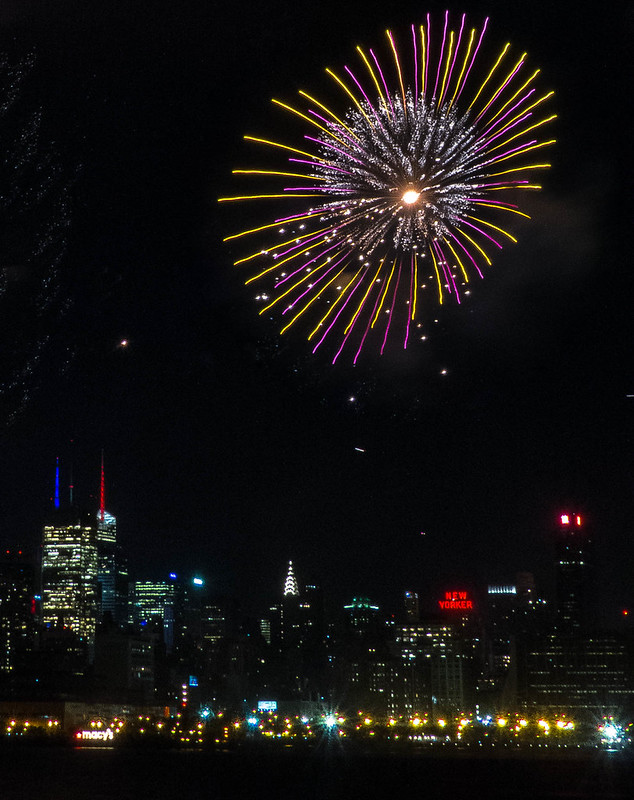
holding color in the trails instead of blowing the core to white. Metered about –1 EV, f/11, ISO 100.
8. Underexpose by About One Stop
Bright fireworks blow out highlights fast, leaving white blobs instead of vivid color. Underexposing slightly — about –1 EV — gives you more control, since it’s easier to brighten shadows in editing than to recover highlights that are already clipped.
Check your histogram after a few frames to confirm nothing’s blown out. When in doubt, shoot darker.
9. Eliminate Shutter Shake
Even the act of pressing the shutter button can introduce enough movement to soften a long exposure. A 2-to-5-second self-timer, a remote shutter release, or your camera’s companion app all solve this by keeping your hands off the body during the exposure.
Gear Tip: A budget remote from Neewer or Pixel is inexpensive and reliable — worth keeping in the bag, especially if you’re running more than one camera.
10. Lock Manual Focus Before the Show Starts
Autofocus doesn’t function in the dark — it hunts and misses the shot entirely. Set your lens to manual, twist to infinity, then back off slightly, since some lenses overshoot true infinity. If your camera has focus peaking, use it to confirm focus visually. Otherwise, test on a distant streetlight or star, zoom in on your LCD, and verify sharpness before the first burst.
Once it’s set, don’t touch the ring again. Adjusting focus mid-show is one of the most common ways photographers lose an otherwise correct shot.

and full bloom in one frame, skyline and reflection intact. Locked manual focus at infinity, f/8, ISO 100.
What to Look for If You’re Buying a Camera for This
You don’t need a $5,000 body to shoot fireworks well, but a few features make a measurable difference: low noise at long exposures, reliable manual controls, and specialty modes like Live Composite.
- Olympus OM-D E-M5 Mark III or II — Live Composite mode layers only new light into the frame, preventing overexposure automatically.
- Sony A7 III or A7C — full-frame low-light performance and dynamic range built for editable, vivid results.
- Fujifilm X-T5 — strong color science and clean RAW files straight out of camera.
- Nikon Z6 II or Z7 II — intuitive manual controls and dependable low-light performance.
Buying used saves hundreds over retail, and a well-maintained secondhand body performs identically to a new one for this kind of shooting. Sellers keep 91.5% on GearFocus compared to roughly 86% on eBay — which means competitive pricing without the marketplace markup layer.
Extra Details That Matter
- Scout early. Arrive hours ahead to find a clear, unobstructed view of the launch site.
- Pack a lens cloth. Fireworks smoke fogs lenses fast.
- Bring spare batteries. Long exposures and Live View drain power quickly.
- Shoot wide. Fireworks move unpredictably — a wider frame gives you room to crop later instead of missing the shot.
- Stay after the finale. The smoky, glowing sky right after the show can produce some of the most distinct frames of the night.
Fireworks photography rewards preparation, not luck. The settings above are the same ten minutes of setup professionals run through before every show — none of it requires expensive gear, just a deliberate approach instead of pointing a camera on auto and hoping.
Browse used cameras built for low-light shooting on GearFocus — where sellers keep 91.5% instead of eBay’s roughly 86%. Or if you’ve got a body sitting in a drawer that’s ready for someone else’s fireworks season, list it here.
FAQ
What’s the best shutter speed for fireworks photography? Start at 3 to 5 seconds for most bursts. Drop to 1 to 2 seconds for rapid-fire finales to avoid a blurred wash of light, and extend to 8 to 10 seconds in dark, rural settings for longer, more dramatic trails.
Can I shoot fireworks photography without a tripod? Yes, though results will be less consistent. A camera braced on a stable surface — a picnic table, a cooler, a wall — with something to dampen vibration underneath can produce usable long exposures in a pinch.
Do I need a full-frame camera for fireworks photography? No. Manual controls, RAW capability, and decent low-light performance matter far more than sensor size. Several APS-C and Micro Four Thirds bodies, including the Fujifilm X-T5 and Olympus OM-D series, handle this well.
Why do my fireworks photos come out overexposed? Most overexposure comes from exposures that are too long relative to the burst frequency, or from not underexposing slightly to protect highlights. Try shortening your exposure by 1–2 seconds or dialing in about –1 EV.
What lens should I use for fireworks photography? A 24–70mm zoom covers most situations. Wide-angle (16–35mm) captures full bursts with foreground context, while telephoto (70–200mm) isolates individual bursts for abstract compositions. Fast aperture doesn’t matter — you’re shooting at f/8 to f/11 regardless.
Where can I buy a used camera for fireworks photography? GearFocus is a peer-to-peer marketplace built specifically for camera gear. Every seller goes through a verification process, and the platform’s 48-hour “as described” verification window gives buyers confidence that general marketplaces don’t offer. Bodies like the Sony a6000, Canon M50, and Olympus OM-D E-M5 regularly list well under retail — practical for a technique you may only use a few nights a year.
Own one like this? Make room for new gear in minutes. Sell Yours & Earn Money →
Own one like this?
Make room for new gear in minutes.
