- Buyer protection on every order
Chasing Star Trails: A Creative Look With a Used DJI Osmo Action
Beth Rogers
Aug 31, 2026
KEY TAKEAWAYS
- The short answer: A used DJI Osmo Action camera plus a small tripod, a spare battery, and a headlamp is enough to shoot star trails and night sky timelapses. The action-cam form factor handles long unattended sessions in the cold better than most mirrorless bodies, and buying used keeps the whole kit affordable.
- The reference look: DJI’s Osmo Action 6 promo footage of a spinning night sky, shot with its variable f/2.0 to f/4.0 aperture. That’s the inspiration, not the shopping list.
- Why now: New flagship launches push previous-generation owners to sell, which is exactly when a used DJI Osmo Action becomes worth hunting for.
- The technique that matters most: Interval-shoot a few hundred frames, then stack them. Star trails are built in post, not captured in one exposure.
- Biggest beginner mistake: Underestimating battery drain in cold air. Bring three, keep two warm against your body.
The first time I tried to shoot star trails, I lasted forty minutes before the cold sent me back to the car. Not the camera. Me. The gear kept working. I was the weak link, standing in a field in a hoodie that had seemed sufficient in the driveway, watching my breath fog up in the beam of a headlamp I’d pointed the wrong way and ruined three frames with.
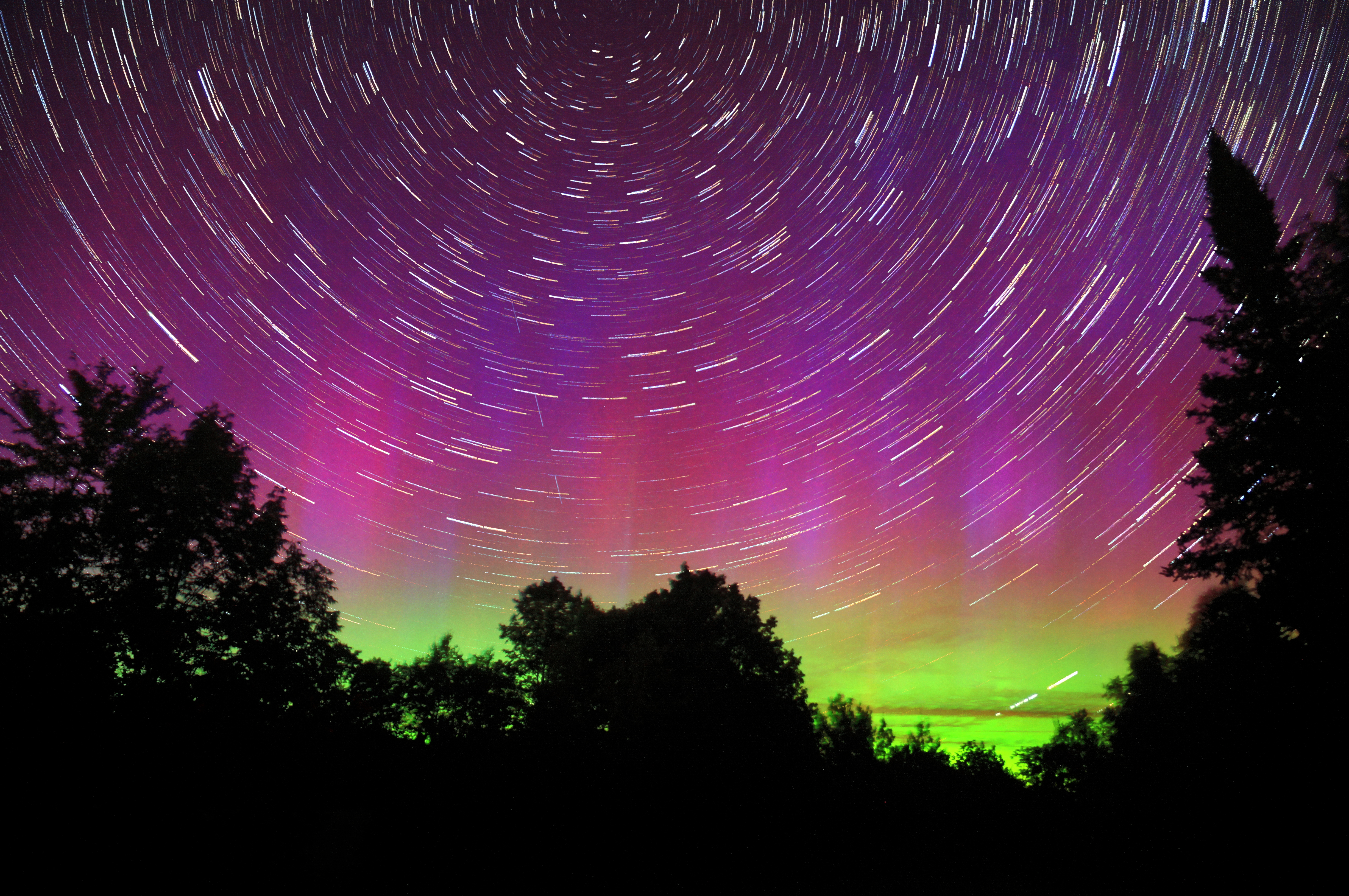
That’s the part nobody puts in the promo video. DJI’s Osmo Action 6 clip shows the sky rotating overhead in perfect silent arcs, the whole vault of stars pivoting around Polaris like a slow machine. What it doesn’t show is the ninety minutes of standing around, the toe-numbing wait, the moment you realize the tripod leg has settled an inch into soft dirt and every frame after that is misaligned.
Here’s the good news. You don’t need the newest body to get close to that look. A used DJI Osmo Action will do it, and the reason it works is the same reason action cameras get overlooked for night work: they’re small, cheap enough to leave out in the weather, and built to run unattended for hours.
You can watch DJI’s Osmo Action 6 star trail footage to see the reference. Then read on for the version you can actually afford.

The Gear List: What Actually Gets You the Star Trail Look
The aspirational version of this shot involves a full-frame body, a fast wide prime, a sky tracker, and a four-figure invoice. The achievable version fits in a jacket pocket. Here’s the split between what inspired the look and what you’d actually buy.
| Piece of Kit | Its Job in the Shot | The Aspirational Version It Stands In For |
|---|---|---|
| Used DJI Osmo Action body | Runs the interval capture unattended for hours in the cold | Full-frame mirrorless body with an intervalometer |
| Fixed wide action-cam lens | Pulls in a huge slice of sky, keeps the whole star field in frame | 14mm or 20mm f/1.4 astro prime |
| Small tabletop or travel tripod | Holds a dead-still frame across hundreds of exposures | Carbon fiber tripod with a leveling base |
| Two or three spare batteries | Keeps the session alive through cold-weather drain | Dummy battery plus a V-mount power bank |
| Free stacking software | Builds the trails from individual frames in post | Star tracker mount doing it optically |
| Red-filtered headlamp | Lets you work without blowing out a frame or your night vision | Same thing, honestly. Nobody’s improved on this. |
That’s the whole rig. A used DJI Osmo Action is the hero piece, and every other line item is either cheap or something you probably own. The stacking software is genuinely free.
The tripod is where people try to save money and shouldn’t. Not because you need an expensive one, but because you need a stable one. A five dollar phone tripod will drift, and drift turns crisp arcs into a smear.
Why a Used DJI Osmo Action Beats a Bigger Camera Out Here
This feels backwards, so let’s deal with it directly. Larger sensors gather more light. On paper, a mirrorless body should crush an action camera at night. And for a single wide-field astro frame, it does.
Star trails are a different problem. You’re not making one exposure. You’re making three hundred short ones and letting software combine them. What matters most in that scenario is a camera that will sit outside for two hours, in dew and wind, without you babysitting it or worrying about the cost of the thing.
A used DJI Osmo Action is weather-sealed straight out of the box. No rain cover, no plastic bag with a rubber band around the lens hood. You set it down, start the interval, and walk back to the car for coffee.
There’s also the psychology of it. I will leave a used DJI Osmo Action unattended on a rock in a dark field. I will not do that with a body worth several thousand dollars, and neither will you, which means the mirrorless kit ends up shooting for forty minutes while you stand next to it, and the action camera shoots for three hours while you sleep in the tent.
The fixed ultrawide lens is the other quiet advantage. Star trails want a big chunk of sky and a foreground anchor, and the wide field on a used DJI Osmo Action gives you that without a lens purchase.
How Do You Shoot Star Trails With a Used DJI Osmo Action?
Set the camera to timelapse or interval mode, lock every automatic setting you can find, and let it run. That’s the whole technique in one sentence. Everything below is refinement.
Lock your white balance. Auto white balance will hunt across a night session and give you frames that shift from blue to amber. Pick a fixed value around 3800K to 4200K and leave it.
Manual focus to infinity, then check it. Autofocus in the dark is a coin flip. Set focus manually before dark if you can, or focus on a distant light and don’t touch it again.
Interval length depends on your shutter. A common starting point is a shutter around 15 to 25 seconds with an interval just slightly longer, so there’s no gap between frames. Gaps show up as dotted lines in the final stack instead of continuous arcs.
ISO lower than instinct says. You’re stacking hundreds of frames, which averages out a lot of noise. Push ISO too high on each individual frame and you’re just baking grain into every layer.
Point at Polaris for the pinwheel. Aim north and the trails curve around a fixed center point. Aim east or west and you get long parallel streaks instead. Both look great, they just look different.
The confession here: for a long stretch I shot star trails with intervals that had two-second gaps and could not work out why my arcs looked like Morse code. Nobody told me. I just kept doing it and blaming the software.
Composing the Foreground So It Isn’t Just Sky

A frame of pure star trails is a science demonstration. A frame with a barn, a ridgeline, or a single crooked tree underneath is a photograph. The difference costs nothing except walking around for ten extra minutes before you set up.
The ultrawide field on a used DJI Osmo Action means you’ll be closer to your foreground subject than feels natural. Get right up on that fence post. What looks intimate to your eye will read as a small detail at the bottom of the frame.
Light painting the foreground works well, but do it once, on a single frame, near the beginning of the sequence. Then you can blend that one lit frame into the finished stack rather than having a strobing foreground across three hundred exposures.
Watch the horizon line. Because the lens is so wide, a tripod that’s slightly off level produces a curved horizon that gets more obvious the longer you look at it.
Stacking: Where the Look Actually Gets Made
The camera captures dots. Software draws the lines. This is the step that surprises people who assumed the trails came out of the camera fully formed.
You load your frame sequence into a stacking application, choose a lighten blend mode, and it keeps the brightest pixel from every frame at each position. Stars move between exposures, so the bright pixels trace paths. That’s it. That’s the whole trick, and it’s why a used DJI Osmo Action can produce this look at all.
Free tools handle this well. StarStaX is the classic one for stills. If your used DJI Osmo Action shot a timelapse video file instead of individual frames, you’ll want to export frames first, which is a five minute step in most editors.
Comet mode is worth trying. Instead of solid arcs, it fades the tail of each trail so the stars look like they’re moving. It’s a stylistic choice and it flatters shorter sessions, since fewer frames means shorter arcs that can otherwise look unfinished.
Gap filling is your fix for those Morse-code frames I mentioned. Most stacking apps have it. It interpolates between frames to close small breaks, which saved me from deleting an entire night’s work more than once.
What to Check When Buying a Used DJI Osmo Action
Action cameras live harder lives than most gear. Mounted on helmets, dropped on rocks, dunked in rivers. Buying used means reading the listing carefully rather than just comparing prices.
The lens cover. On most Osmo Action models this is a replaceable element, which is great, but scratches on it will flare badly against point light sources. Stars are point light sources. Ask for a photo of the front glass at an angle.
Battery health. Batteries are consumables. A used DJI Osmo Action with two tired batteries isn’t a problem if you factor in a fresh set, but you should factor it in rather than discover it in a dark field.
Waterproof seal condition. Check the battery door gasket and the port cover. A degraded seal is the difference between a camera you’ll leave out in dew and one you won’t.
Screen and rear display. Cracked screens on these are common and often cosmetic, but confirm the touch response works, because you’ll be navigating menus with cold fingers in the dark.
Every seller on GearFocus is identity-verified, and the standard buyer protection gives you 48 hours after delivery to check the camera and return it at no charge if it isn’t as described. For a category with as much hard use as action cameras, that inspection window is the thing I’d care about most.
Timing Your Purchase: Why Right Now Is Interesting
DJI’s Osmo Action 6 promo footage is doing what flagship launches always do. It’s making current owners look at their Action 5 Pro and think about upgrading, and upgrade thinking is what fills the used market with clean bodies from people who took care of them.
That’s the honest reason a used DJI Osmo Action is worth watching for as we head into fall 2026. Used prices generally soften once a successor arrives and previous-generation owners start listing, though how much and how fast varies by model.
Late summer into autumn also happens to be good star trail season in much of the northern hemisphere. Longer nights, more comfortable temperatures than deep winter, and the Milky Way core still visible in the earlier evening for part of it.
If you already own an older Osmo Action or a drone you’ve stopped flying, this cuts both ways. Buyers are actively searching for exactly that gear, and sellers on GearFocus keep 91.5% of the sale price thanks to the 8.5% total fee. That’s meaningfully more than the generalist marketplaces take. We’ve even run giveaways around DJI gear for sellers in the past.
Pairing a Used DJI Osmo Action With Other Night Gear
The action camera doesn’t have to work alone. Some of the strongest night sequences I’ve seen combine a locked-off star trail stack with a second angle from something else entirely.
A drone gives you elevation, which changes the relationship between your foreground and the sky. Our guide to affordable used drones for aerial photography covers the models worth considering if you want that second perspective without a big outlay.
A phone on a second tripod is genuinely useful for scouting compositions before you commit the used DJI Osmo Action to a two-hour session. Modern phone night modes will show you roughly what’s up there in a few seconds.
And a cheap dew heater strip, the kind astronomers use, wraps around the lens barrel and stops condensation from fogging your frames halfway through the night. This is the single most underrated accessory in night photography and it costs less than dinner.
BOTTOM LINE
- Hero gear: One used DJI Osmo Action body, a stable compact tripod, three batteries, a red headlamp, and free stacking software.
- Camera settings: Manual focus at infinity, fixed white balance around 4000K, moderate ISO, shutter of roughly 15 to 25 seconds, interval with no gap.
- Post workflow: Lighten-mode stack in StarStaX or equivalent, gap-fill any breaks, blend in one light-painted foreground frame.
- Buying checklist: Front glass condition, battery health, seal and gasket integrity, working touchscreen.
- Composition rule: Get closer to your foreground than feels right, aim north for pinwheel arcs, keep the horizon level.
Go Stand in a Field
The gap between DJI’s polished promo reel and what you can make yourself is narrower than the marketing implies. It’s mostly patience, a level tripod, and a willingness to be cold for a while. The used DJI Osmo Action does the technical work; you do the standing around.
Bodies from previous generations come up on GearFocus regularly, and with the flagship refresh cycle pushing owners to list, this is a sensible stretch to be watching. Worth a look if a used DJI Osmo Action is on your list, whether you’re chasing star trails or just want a small weatherproof camera you’ll actually leave outside.
FAQ
Can a used DJI Osmo Action really shoot star trails?
Yes. Star trails are built by stacking hundreds of short interval exposures in software, not by one long exposure. A used DJI Osmo Action handles the interval capture and weather exposure well.
What camera gives you the star trail look for less?
An action camera. A used DJI Osmo Action costs a fraction of a full-frame astro setup, is weather-sealed for unattended overnight sessions, and its ultrawide fixed lens covers plenty of sky without a separate lens purchase.
How many frames do I need for good star trails?
Aim for at least 150 to 200 frames at roughly 20 seconds each, which is about an hour of shooting. Longer sessions produce longer, more dramatic arcs across the sky.
Do I need a star tracker?
No. Trackers keep stars as points during long single exposures. Star trails want the opposite effect, so a locked-off tripod and interval shooting is exactly the right approach here.
What should I check before buying a used action camera?
Inspect the front lens glass for scratches, confirm battery health, check the waterproof gaskets on the battery door and port cover, and verify the touchscreen responds correctly.
Photo: Aurora Trails – 46 Frames by Mike Lewinski, CC BY 2.0
Own one like this?
Make room for new gear in minutes.
