- Buyer protection on every order
Nikon Nirvana: Chasing the Vintage Camera Collection Look With Used Gear
Bill Pryor
Sep 30, 2026
KEY TAKEAWAYS
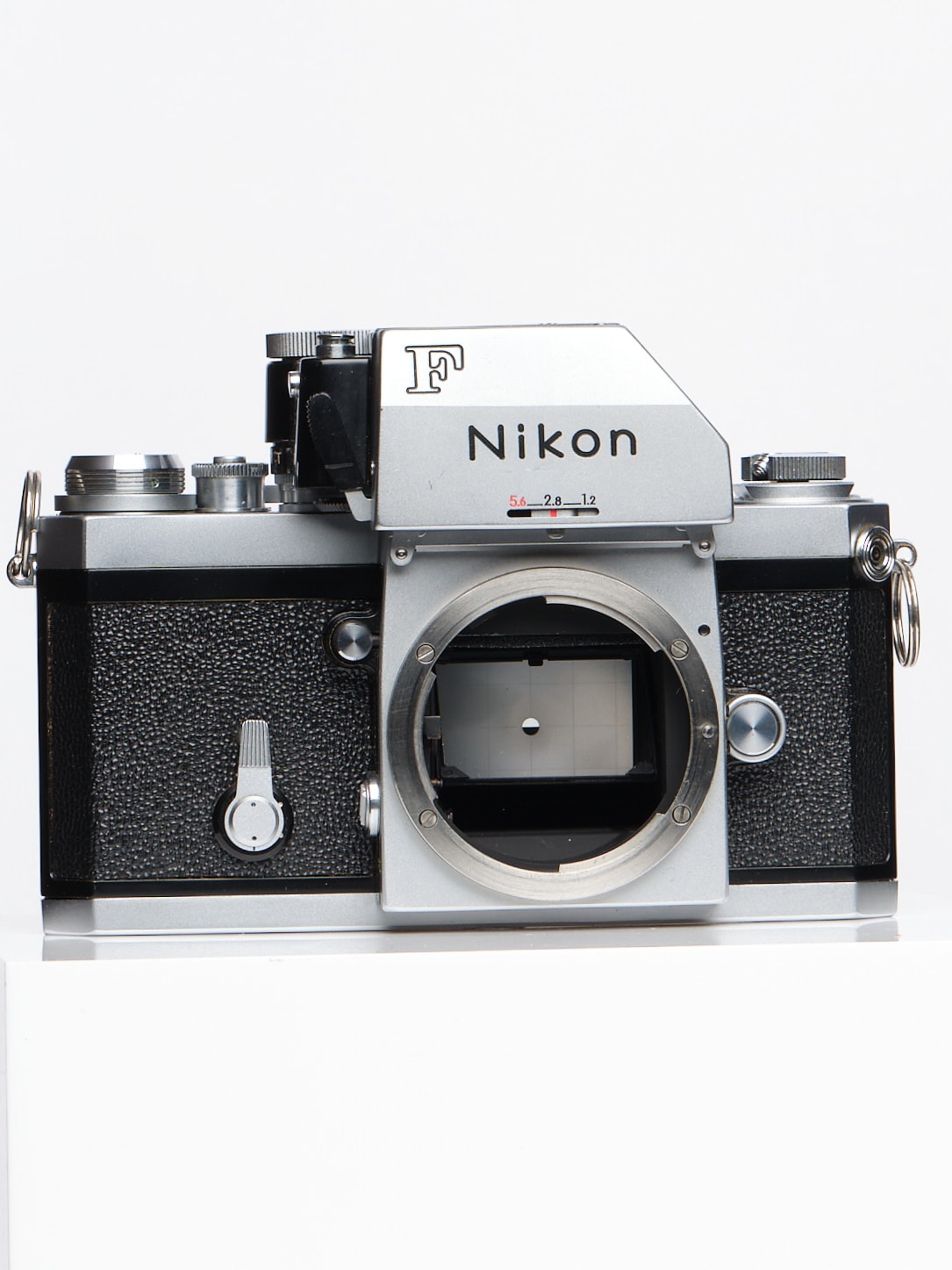
- The short answer: A working vintage Nikon camera collection starts with a Nikon F film body and a handful of manual F-mount primes. GearFocus GearMaster data lists the Nikon F as a 35mm SLR built between 1950 and 1959, 820g, focal plane shutter, manual focus only. That one body plus two lenses is the entire foundation.
- The reference point is a museum, not a shopping list: Matt Granger’s Nikon Museum tour in Tokyo shows glass most of us will never touch. The achievable version uses the same mount.
- The mount is the whole trick: Nikon F mount lenses from the manual era still bolt onto bodies made decades apart, which is why a vintage Nikon camera collection compounds instead of fragmenting.
- The weird-uncle pick: The Nikon E2Ns, a 1.3MP professional DSLR on an F4-derived metal body, 1,850g, is the strangest thing you can add to a vintage Nikon camera collection and still shoot with.
- Buy bodies for character, lenses for use: Bodies sit on shelves. Glass keeps earning. Weight the budget accordingly.
There’s a particular quality of light in a glass display case. Flat, even, slightly cold, coming from LED strips tucked into the top edge so nothing casts a shadow. Chrome top plates catching it. Rows of black leatherette going soft under it. You can hear your own shoes on the floor because nobody talks above a murmur in a room like that, and the whole thing smells faintly of carpet cleaner and climate control. That’s the Nikon Museum in Tokyo, and that’s roughly the feeling Matt Granger’s walkthrough of the collection gives you: reverence, and a mild ache.
Then you walk out, and the ache turns practical. Because a vintage Nikon camera collection you can actually assemble looks nothing like a museum vitrine. It looks like three bodies and five lenses in a canvas bag, and most of it cost less than one modern zoom.
Here’s the deal. The museum gear is the reference point. It is not the purchase. What you buy instead is the same lens mount, the same mechanical logic, the same tactile experience, sourced from the used market where this stuff has been quietly circulating for sixty years.
What Goes In a Vintage Nikon Camera Collection You Actually Shoot?
Start with the anchor. Everything else in a vintage Nikon camera collection hangs off one decision, and that decision is the body you’ll put film through most often.
| Piece | Role in the look | Museum reference it stands in for |
|---|---|---|
| Nikon F film camera (35mm SLR, 820g, manual focus, focal plane shutter) | The working body. Mechanical shutter, no battery dependency, full manual control | The rare early professional bodies behind the museum glass |
| Manual-focus Nikon F mount standard lens | Everyday optic. Rendering and focus feel that define the era | Specialty and prototype optics you’ll never handle |
| Manual-focus F mount wide-angle | Street, interiors, landscape coverage | Exotic wide glass in the display cases |
| Manual-focus F mount telephoto | Compression, portraits, isolation | Long museum-piece telephotos on their own stands |
| Nikon E2Ns DSLR (2/3-inch sensor, 1.3MP, 1,850g, ISO 800–3200) | The oddity. A digital footnote you can still fire | Early digital prototypes displayed as history |
Total shape of the kit: one film body, three manual primes, one strange digital body. That’s a vintage Nikon camera collection with a spine.
The Nikon F: The Body Your Vintage Nikon Camera Collection Is Built Around
Per GearFocus GearMaster data, the Nikon F film camera is a 35mm single-lens reflex on the Nikon F mount, manufactured between 1950 and 1959, weighing 820g, with a focal plane shutter and manual focus operation. Those are unglamorous numbers until you sit with what they mean.
The focal plane shutter is mechanical. No battery dependency for the shutter to fire. You can leave this body in a drawer for four years, pull it out, load film, and shoot. Try that with anything that has a firmware version number.
The 820g matters too, and not in the way spec sheets usually mean. GearMaster lists the weight as a genuine limitation for extended handheld work, and it is. But that mass is also why the body sits still against your face. Slow shutter speeds get easier when the camera itself refuses to twitch.
The F mount is the real inheritance. GearMaster notes it supports standard, wide-angle, telephoto, zoom, and specialty optics. Interchangeable, brand-specific, and broadly available on the used market. That compatibility is the engine of every serious vintage Nikon camera collection, because glass you buy for this body doesn’t strand you later.
Flash connectivity runs through both a hot shoe and a PC sync port, which gives you options with studio strobes and older speedlights alike. GearMaster is honest that advanced TTL functionality can’t be verified from the available specs, so plan on manual flash and be pleasantly surprised if you get more.
The limitation you have to actually accept: manual focus only. No tracking. No eye detection. Nothing between your fingers and the focus ring. For street, portrait, landscape, night, and creative-effects work, which is exactly what GearMaster lists as its use cases, that’s a feature. For a kid on a scooter, it’s a problem.
Manual Glass: Where the Vintage Nikon Camera Collection Earns Its Keep
I’ll confess something. When I started buying into old Nikon gear, I did it backwards. I chased bodies. Chrome ones, black ones, ones with dented prisms and stories I invented for them. I ended up with a shelf of cameras and two lenses, which is a museum, not a kit.
Flip it. Bodies are the frame. Lenses are the picture. A vintage Nikon camera collection built around three excellent manual primes and one honest body will out-shoot a collection of six bodies and a kit zoom every single time.
Manual F mount primes render differently than modern glass, and not by accident. Fewer elements, older coatings, less aggressive correction. Highlights bloom instead of clipping hard. Out-of-focus areas swirl and smear in ways a computer-optimized design specifically engineers out. That’s the look people are chasing when they say a photo feels like film, and half of it isn’t the film at all.
Pros noticed this years ago. Our piece on why working photographers keep quietly buying used lenses covers the economics, and the short version is that optical quality stopped being the bottleneck a long time ago. Character became the differentiator.
Practical sequence for building the glass side of a vintage Nikon camera collection: standard focal length first, because it teaches you to move your feet. Wide second, because interiors and street work demand it. Telephoto third, because compression is a want, not a need, until suddenly it is.
The Nikon E2Ns: The Strange One in Every Vintage Nikon Camera Collection
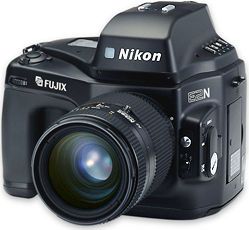
Now the oddity. Per GearFocus GearMaster data, the Nikon E2Ns DSLR is a professional-grade digital camera on a metal body derived from the F4 platform, measuring 164 x 160 x 120 mm and weighing 1,850g. It captures 1.3MP images at a maximum resolution of 1280×1000 from a 2/3-inch sensor, with an ISO range of 800 to 3200.
Read those numbers again. 1.3 megapixels. 1,850 grams. That is roughly the mass of two Nikon F bodies to produce a file smaller than a phone screenshot.
And yet. Phase detection autofocus. Burst shooting at up to 3 frames per second. An optical pentaprism viewfinder for direct optical framing. The Nikon F lens mount, which means your manual primes bolt straight on. It is a genuine professional tool from the moment digital was still arguing with itself about whether it belonged in a working kit.
GearMaster is blunt about the limitations, and they’re worth stating plainly. The 1.3MP resolution is extremely limited by contemporary standards. There is no image stabilization of any kind, neither in-body nor digital. No Wi-Fi, no Bluetooth, no USB connectivity, which makes getting files off it an exercise in patience and adapters.
So why include it in a vintage Nikon camera collection at all? Because it’s the hinge. It’s the piece that shows the F mount surviving the transition from film to digital without blinking. Every museum collection tells a story through sequence, and this body is the paragraph where the story turns.
If you want the neighboring chapter, the Nikon E3 DSLR sits right alongside it in the same early-digital lineage.
Buying Old Gear Without Getting Burned
Second confession, and this one still stings. I once bought an old SLR because the seller photo made the leatherette look immaculate. It was. The shutter curtains were not. They had a pinhole the size of a grain of sand, and I burned three rolls before I figured out the mystery streak wasn’t a light leak in my darkroom technique.
So: ask about the shutter. On a mechanical body, ask whether it fires at every marked speed and whether the slow speeds hang. Ask about the curtains specifically. Ask whether the film advance feels smooth or gritty.
On lenses, ask about fungus, haze, and separation, in that order. Ask whether the aperture blades snap shut cleanly or move like they’re dragging through syrup. Oil on blades is common on manual glass and usually fixable, but you want to know before, not after.
On GearFocus, seller identities are verified, and the standard buyer protection runs 48 hours from delivery: if the item isn’t as described, you return it at no charge and the seller covers return shipping. For a vintage Nikon camera collection assembled from bodies nobody has serviced since the Carter administration, that window is the whole ballgame. Use it. Load a roll, fire every speed, check the glass against a bright window.
One note on condition tiers: items listed as Poor or As-Is are final sale, no returns. That’s often exactly the right buy for a display piece or a parts body, but go in clear-eyed about what you’re accepting.
If you’re new to buying pre-owned entirely, our explainer on why buying used photography gear makes sense covers the broader case.
How the Vintage Nikon Camera Collection Actually Gets Used
A collection that never leaves the shelf is furniture. Here’s how the pieces divide up in practice.
The Nikon F goes out for street and travel. GearMaster lists street, night, and creative effects among its use cases, and that tracks with how the body behaves. No autofocus hunting, no autoexposure second-guessing, no menu. You set aperture, you set shutter, you zone focus, you walk. The camera gets out of the way because there’s nothing in it to get in the way.
Portraits go to the F with the telephoto prime. Manual focus on a still subject is not a handicap, it’s a rhythm. You focus, they settle, you focus again, and the shot arrives because you both waited for it.
Landscape and night work suit the mechanical shutter. Cold weather kills batteries. A focal plane shutter with no battery dependency does not care that it’s fourteen degrees at the trailhead at 5 a.m.
The E2Ns comes out when you want the artifact. 1.3MP files from a 2/3-inch sensor at ISO 800 look exactly like what they are: early digital, soft, noisy, weirdly beautiful in a way nobody has successfully faked with a filter. It’s a texture, not a tool.
And if this whole era of odd formats and forgotten cameras appeals to you, the rabbit hole goes deeper. Our look at vintage 110 film SLRs on the used market is a reminder that Nikon wasn’t the only company building strange, wonderful things.
Timing Your Buys in Late 2026
It’s late September 2026, which means two things for anyone assembling a vintage Nikon camera collection.
First, holiday gifting season is roughly eight weeks out. Old cameras photograph beautifully and make obvious gifts, which historically tightens supply on the most recognizable bodies as November approaches. If a specific chrome body is on your list, earlier is calmer than later.
Second, autumn is prime shooting season, and film bodies that have been sitting all summer tend to come to market as people rebalance their kits. Manual glass in particular moves steadily this time of year.
Used Nikon F bodies and manual F mount lenses come up regularly on GearFocus, and browsing the current marketplace listings is a reasonable way to see what’s actually circulating rather than what you imagine is. Have an old Nikon sitting in a closet? Sellers keep 91.5% of the sale price here, and buyers are actively searching for exactly this gear.
BOTTOM LINE
- Nikon F film camera: 35mm SLR, 1950–1959, 820g, focal plane shutter, manual focus, hot shoe and PC sync. The anchor of the vintage Nikon camera collection.
- Manual F mount standard prime: Everyday rendering. Buy this before any second body.
- Manual F mount wide-angle: Street, interiors, landscape.
- Manual F mount telephoto: Compression and portrait isolation.
- Nikon E2Ns DSLR: 1.3MP, 2/3-inch sensor, 1,850g, ISO 800–3200, phase detection AF, 3fps. The history piece in a vintage Nikon camera collection, and still shootable.
- Protection: 48-hour verification window after delivery on standard listings. Poor and As-Is items are final sale.
Where This Leaves You
The Nikon Museum exists to make you feel something. It succeeds. But the cameras behind that glass were working tools before they were relics, and the mount they share is still the most quietly generous thing Nikon ever did. A vintage Nikon camera collection built today runs on that generosity: one mechanical body, three manual primes, one absurd early digital footnote, all speaking the same language.
Buy the glass first. Shoot the body until the leatherette goes shiny under your thumb. That’s how a vintage Nikon camera collection stops being a display and becomes a kit, and it starts with a single Nikon F.
FAQ
What camera should start a vintage Nikon camera collection?
The Nikon F film camera. GearFocus GearMaster data lists it as a 35mm SLR built 1950–1959, 820g, with a focal plane shutter and manual focus. Its F mount accepts standard, wide, telephoto, zoom, and specialty lenses.
Do old manual Nikon lenses still fit modern Nikon bodies?
F mount manual lenses share the same physical mount across decades of Nikon bodies, film and digital alike. The Nikon E2Ns uses the F mount too. Metering and autofocus support vary by body, so confirm compatibility before buying.
Is the Nikon E2Ns worth owning today?
As a shooting camera, barely. It captures 1.3MP at 1280×1000 with no stabilization and no Wi-Fi, Bluetooth, or USB. As a piece of early-digital history on an F4-derived metal body, it earns its shelf space.
How much weight should a vintage Nikon camera collection put on bodies versus lenses?
Lenses. Bodies define the experience, but glass defines the images and holds value better. A single Nikon F with three good manual primes outperforms a shelf of bodies sharing one kit lens.
What should I check before buying an old Nikon film body used?
Shutter accuracy at every marked speed, slow-speed hang, pinholes in the curtains, and film advance smoothness. On lenses, check for fungus, haze, element separation, and oily aperture blades. Test everything inside the 48-hour verification window.
Own one like this?
Make room for new gear in minutes.
