Deardorff 8x10 Folding View Camera
The Deardorff 8x10 is a film camera from Deardorff — known for its 8x10 Large Format and Multi-Format Compatibility. Check GearFocus for current availability, with buyer protection on every purchase.
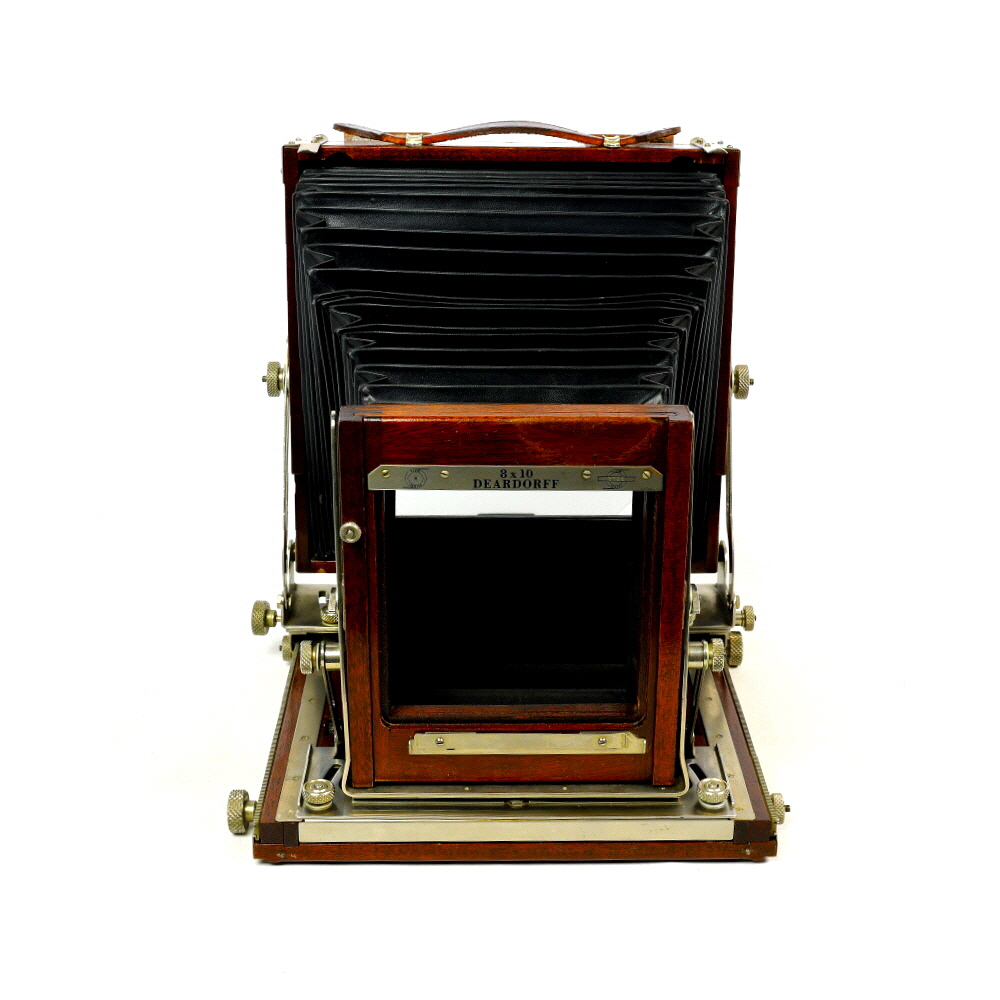
Deardorff 8x10 Folding View Camera
Get notified when one lists.
We'll text or email you the moment a Deardorff 8x10 Folding View Camera is listed on GearFocus.
Have a Deardorff 8x10 sitting in your bag?
You'd be the first listing for this model.
Serious buyers are already watching — list yours in minutes.
Camera Overview — Deardorff 8x10
Key Features — Deardorff 8x10
8x10 Large Format: Captures images on 8x10 inch sheet film, producing negatives with exceptional detail and tonal range suited to fine art and commercial printing.
Multi-Format Compatibility: Accepts sheet film in 4x5, 5x7, and 8x10 formats via reducing backs, allowing the same camera body to serve multiple large-format workflows.
Folding Field Design: Folds into a compact, self-contained unit for transport, making it practical to bring into the field despite its 8x10 format size.
Full View Camera Movements: Offers front and rear rise, fall, shift, tilt, and swing for precise perspective and plane-of-focus control.
Standard Lens Board Mount: Accepts interchangeable lens boards compatible with a wide range of large format barrel lenses, giving photographers broad optics flexibility.
American Hardwood Construction: Built from mahogany and cherry wood with brass hardware, reflecting the hand-crafted quality Deardorff was known for during this era.
Camera Specifications — Deardorff 8x10
| Spec | Detail |
|---|---|
| Use Cases | Studio, Architecture, Landscape |
Description — Deardorff 8x10
The Deardorff 8x10 Folding View Camera is a view camera built during the 1950–1959 manufacturing period, offering a hands-on large-format shooting experience grounded in mechanical precision. It accepts sheet film in 4x5, 5x7, and 8x10 formats, making it a versatile platform for photographers working across different large-format sizes. Lenses attach via a lens board (technical camera) interface compatible with large format barrel lenses, providing access to a broad selection of optics.
Operation is fully manual, with manual focus and a mechanical shutter that requires no electronic components. At 6.5–7 lbs, the camera strikes a practical balance for an 8x10 instrument intended for tripod-based use. For photographers committed to the large-format sheet film process, this Deardorff represents a durable, period-correct tool with a legacy of professional use.
Pros — Deardorff 8x10
- ✓Multi-format film compatibility — accepts sheet film in 4x5, 5x7, and 8x10 formats
- ✓Lens board mount system is compatible with large format barrel lenses, offering broad optics flexibility
- ✓Mechanical shutter operation requires no batteries or electronics
Cons — Deardorff 8x10
- ✗Manual focus only — no autofocus option, requiring careful focusing technique with each shot
- ✗Sheet film workflow is slow and deliberate, limiting shooting pace compared to roll-film cameras
- ✗As a vintage camera from the 1950s, servicing and replacement parts may be difficult to source
Videos — Deardorff 8x10
Unboxing and first impressions review of the VDS 8X10 camera — CatLABS JP