Nikon Nikkor AF-S DX 18-300mm f/3.5-5.6G ED VR Lens
The Nikon AF-S DX Nikkor 18-300mm f/3.5-5.6G ED VR is a lens from Nikon. Check GearFocus for current availability, with buyer protection on every purchase.
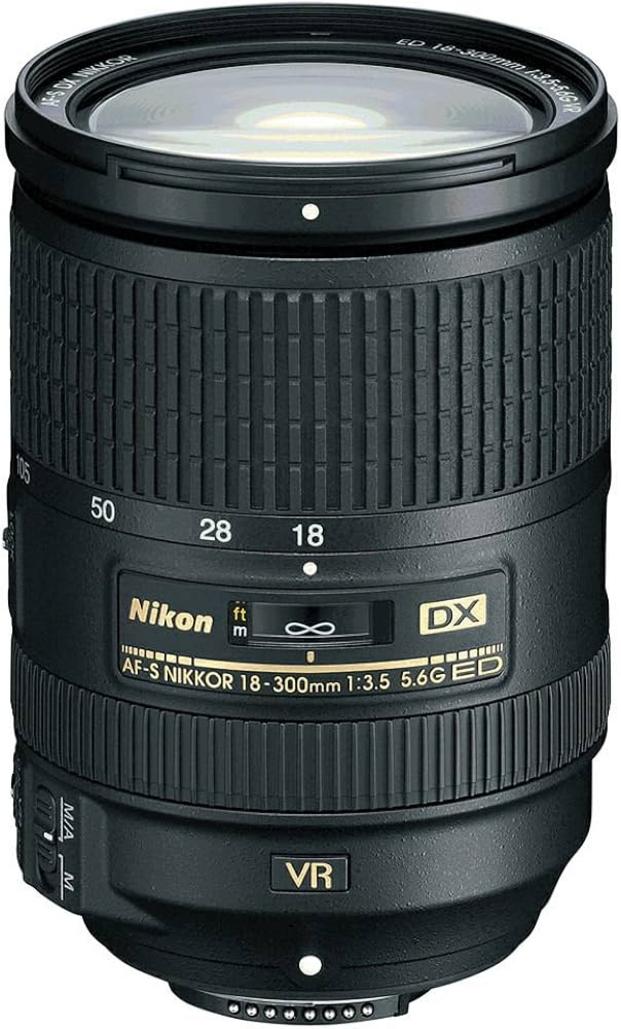
Nikon Nikkor AF-S DX 18-300mm f/3.5-5.6G ED VR Lens
Get notified when one lists.
We'll text or email you the moment a Nikon Nikkor AF-S DX 18-300mm f/3.5-5.6G ED VR Lens is listed on GearFocus.
Have a Nikon AF-S DX Nikkor 18-300mm f/3.5-5.6G ED VR sitting in your bag?
You'd be the first listing for this model.
Serious buyers are already watching — list yours in minutes.
Available Now on GearFocus


Lens Overview — Nikon AF-S DX Nikkor 18-300mm f/3.5-5.6G ED VR
Key Features — Nikon AF-S DX Nikkor 18-300mm f/3.5-5.6G ED VR
18-300mm Superzoom Range: A 16.7x zoom ratio covers wide-angle through long telephoto on DX bodies, equivalent to roughly 27-450mm in full-frame terms, making it a true all-in-one travel lens.
f/3.5-5.6 Maximum Aperture: Holds f/5.6 at 300mm rather than dropping to f/6.3 like most third-party superzooms, giving you one full stop of extra light at the telephoto end.
AF-S Silent Wave Motor: Nikon's internal Silent Wave Motor drives autofocus quickly and quietly, and full-time manual focus override is available without switching modes.
Vibration Reduction (VR): Nikon's optical image stabilization compensates for camera shake across the entire zoom range, particularly useful at longer focal lengths where blur is harder to avoid.
ED Glass Elements: Extra-low Dispersion glass elements are included in the optical design to reduce chromatic aberration and color fringing, especially at the wide and telephoto extremes.
9-Blade Diaphragm: Nine rounded aperture blades produce 18-armed sun stars at small apertures and contribute to smoother out-of-focus rendering at longer focal lengths.
Description — Nikon AF-S DX Nikkor 18-300mm f/3.5-5.6G ED VR
The Nikon AF-S DX Nikkor 18-300mm f/3.5-5.6G ED VR is a superzoom lens built for APS-C / DX format cameras, mounted via the Nikon F (DX) mount. Its focal length range spans 18mm to 300mm, with a maximum aperture of f/3.5 at the wide end and f/5.6 at the telephoto end — a notable advantage over third-party alternatives that drop to f/6.3 at 300mm. Autofocus is handled by an AF-S Silent Wave Motor, and Vibration Reduction (VR) is built in to help manage camera movement.
The optical design incorporates ED (Extra-low Dispersion) elements and a 9-blade diaphragm that produces 18-armed sun stars. Sharpness performs best around 50mm, while telephoto performance at 300mm wide open shows reduced contrast and edge softness. Chromatic aberration is visible at 18mm and around 50mm, with in-camera JPEG correction available on compatible bodies.
Strong barrel distortion at 18mm and pincushion distortion across the mid-to-telephoto range are present, with varying degrees of in-camera and software correction available. The lens carries considerable size and weight as a natural result of its broad zoom range and aperture specification.
Pros — Nikon AF-S DX Nikkor 18-300mm f/3.5-5.6G ED VR
- ✓Wide 18-300mm focal length range covers a broad shooting spectrum in a single lens
- ✓Maximum telephoto aperture of f/5.6 — one stop brighter than third-party competitors that drop to f/6.3 at 300mm
- ✓AF-S Silent Wave Motor enables smooth, quiet autofocus operation
Cons — Nikon AF-S DX Nikkor 18-300mm f/3.5-5.6G ED VR
- ✗Telephoto sharpness wide open is poor — low contrast, struggles with fine detail, significantly worse toward frame edges
- ✗Strong barrel distortion at 18mm that cannot be fully corrected even at maximum in-camera adjustment
- ✗Tendency toward slight misfocusing at 300mm, particularly in portrait orientation — noted as disturbingly prevalent
Videos — Nikon AF-S DX Nikkor 18-300mm f/3.5-5.6G ED VR
Nikon 18-300mm VR Lens Review — Jared Polin