Welta Superfekta Folding TLR Camera
The Welta Superfekta is a film camera from Welta — known for its Folding TLR Configuration and 120 Medium Format Film. Check GearFocus for current availability, with buyer protection on every purchase.
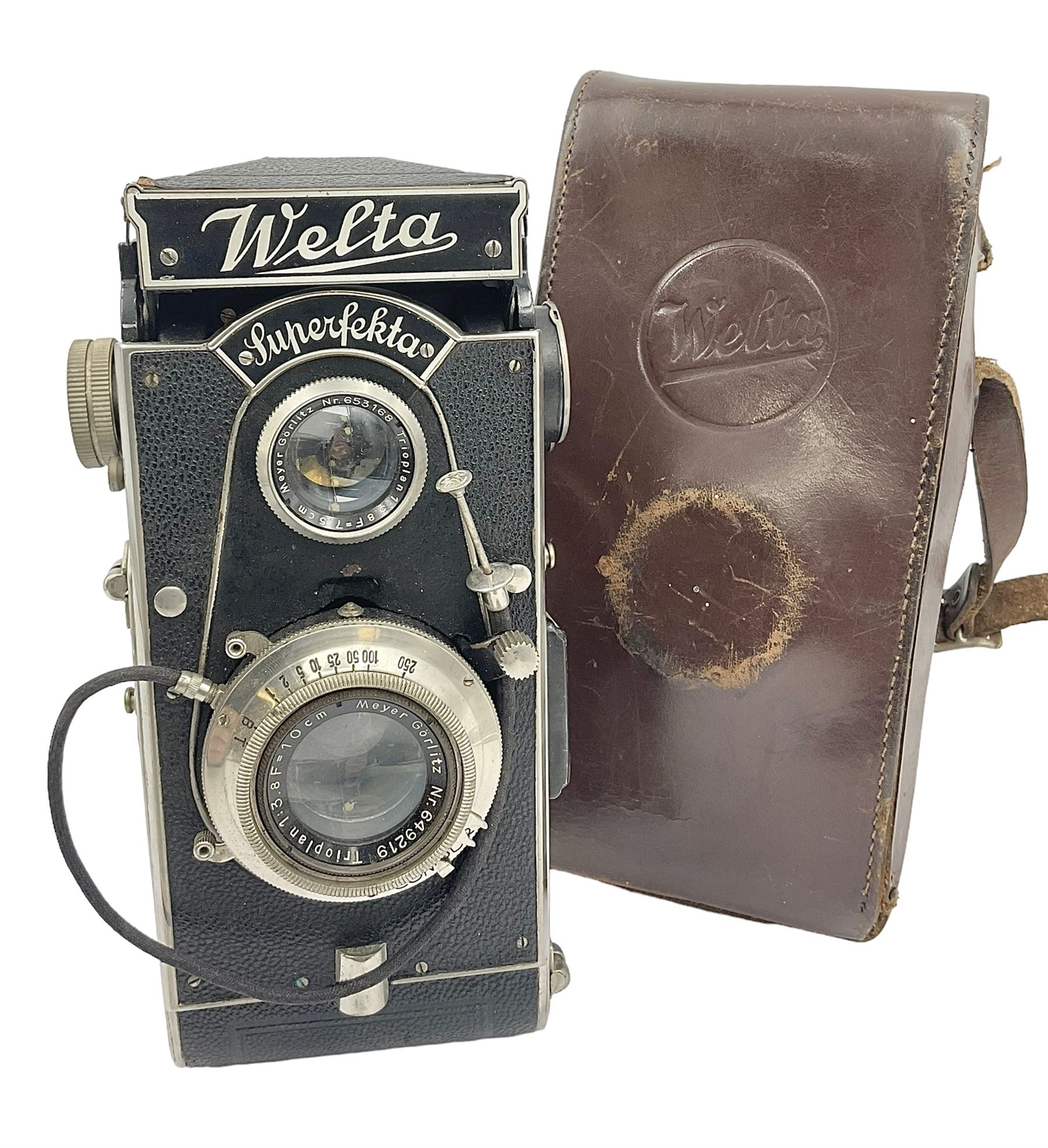
Welta Superfekta Folding TLR Camera
Get notified when one lists.
We'll text or email you the moment a Welta Superfekta Folding TLR Camera is listed on GearFocus.
Have a Welta Superfekta sitting in your bag?
You'd be the first listing for this model.
Serious buyers are already watching — list yours in minutes.
Camera Overview — Welta Superfekta
Key Features — Welta Superfekta
Folding TLR Configuration: Combines a twin-lens reflex viewing system with a collapsible folding body — an unusually rare design that most TLR cameras of the era did not offer.
120 Medium Format Film: Shoots on 120 roll film, a format that remains in commercial production today and capable of producing large, high-detail negatives.
Waist-Level Viewfinder: TLR design provides a waist-level ground glass viewing experience for composing shots from a low, stable position.
Leaf Shutter Mechanism: Built-in leaf shutter operates quietly and with minimal vibration, which is well-suited to handheld and close-up shooting.
Fixed Lens System: The taking and viewing lenses are permanently integrated into the camera body, keeping the optical system self-contained.
Manual Focus Only: Focusing is performed manually, giving the photographer direct control without reliance on any automatic systems.
Camera Specifications — Welta Superfekta
| Spec | Detail |
|---|---|
| Use Cases | Portrait, Landscape, Street, Creative Effects |
| Type | Film |
Description — Welta Superfekta
The Welta Superfekta is a folding twin-lens reflex camera produced during the 1950s, representing a genuinely uncommon design in the history of film cameras. While most TLR cameras of the era were fixed-body designs, the Superfekta incorporated a folding mechanism that allowed it to collapse for portability — an engineering choice that makes it a distinctive collectible today. The camera is built around 120 medium format film, a format that continues to be manufactured and available, making real-world use feasible for dedicated film photographers.
Focusing is manual, and the shutter is a leaf-type design integrated into the fixed, non-interchangeable lens assembly. Flash compatibility is listed as none. The Superfekta is best suited for collectors seeking a historically interesting German-made folding TLR, or for experienced film photographers prepared to work with vintage equipment in available light.
Pros — Welta Superfekta
- ✓Rare folding TLR design from the 1950s — an unusual combination of two distinct camera formats
- ✓Shoots 120 medium format film, which is still commercially available today
- ✓Leaf shutter design, standard for folding cameras of this era and generally quiet in operation
Cons — Welta Superfekta
- ✗No flash compatibility, limiting shooting to available light situations only
- ✗Fixed lens means no ability to swap optics for different focal lengths or apertures
- ✗As a 1950s vintage camera, age-related mechanical wear or shutter issues should be anticipated and inspected before use
Videos — Welta Superfekta
Welta Perfekta TLR Folding. — Unusual Lab