- Buyer protection on every order
Tamron 16-50mm F2.8 Launch: Value Guide for Used APS-C Kit Lenses
Bill Pryor
Oct 23, 2026
KEY TAKEAWAYS
- The short answer: Tamron’s new 16-50mm F2.8 lands under $550 for APS-C bodies, and that price ceiling now caps what every older fast standard zoom can realistically ask. If you own used APS-C kit lenses, sell the ones you don’t shoot. If you’re buying, your leverage just improved.
- The squeeze is from above, not below: A sub-$550 new lens with a warranty pressures the $300-$450 used tier hardest, which is exactly where most used APS-C kit lenses sit.
- Stabilization is the dividing line: GearFocus GearMaster data shows the Tamron B005 17-50mm f/2.8 carries optical stabilization at 570g, while the older A16 17-50mm f/2.8 has none at 430g. One of those holds value better on older bodies.
- Mount matters more than optics: Both of those Tamrons are Canon EF and Nikon F only. DSLR-mount used APS-C kit lenses were already a shrinking pool, and a modern mirrorless-mount alternative doesn’t help them.
- Buying strategy for late 2026: Wait out the announcement noise, then buy in the gap before holiday demand. Selling? List now, before the first shipping reviews land.
Tamron just announced a 16-50mm F2.8 for APS-C that undercuts $550, and if you own used APS-C kit lenses, that number is the only one that matters this month. A constant-aperture standard zoom, brand new, with a warranty, for less than most people were paying for a well-kept secondhand one a year ago. That changes the math on an entire shelf of glass.
I want to be careful here, because gear announcements breed a specific kind of panic. Somebody sees a headline, decides their lens is worthless, and dumps it for half of what a patient seller would have gotten. That’s not what’s happening. But something is happening, and it’s worth understanding before you list anything or click Buy.
Here’s the deal. New product announcements don’t crater used prices overnight. They compress the ceiling. And the ceiling on used APS-C kit lenses was already lower than most owners wanted to admit.
Why a Sub-$550 Lens Reprices Used APS-C Kit Lenses
The announcement came through DPReview, which framed it bluntly: this is a fast, sub-$550 kit lens replacement for every APS-C system. That last phrase is the one doing damage. Not one mount. Every system.
Think about what a used lens actually competes against. Not other used lenses, not really. It competes against the cheapest acceptable new option. When that new option sits at $1,100, a $400 secondhand copy looks like a steal. When the new option drops to $549 with a warranty and current autofocus, a $400 used copy suddenly needs to justify itself.
That’s the compression. Used APS-C kit lenses in the $300-$450 band are now sandwiched into a narrow strip of value where the only arguments left are mount compatibility, stabilization, and sentiment.
I’ve watched this pattern before with wide zooms. We covered it when Tamron shipped the 12-20mm and the used 11-20mm and 17-28mm prices adjusted in response. The same mechanics apply to used APS-C kit lenses now, just across a far bigger installed base.
What Actually Holds Value in Used APS-C Kit Lenses
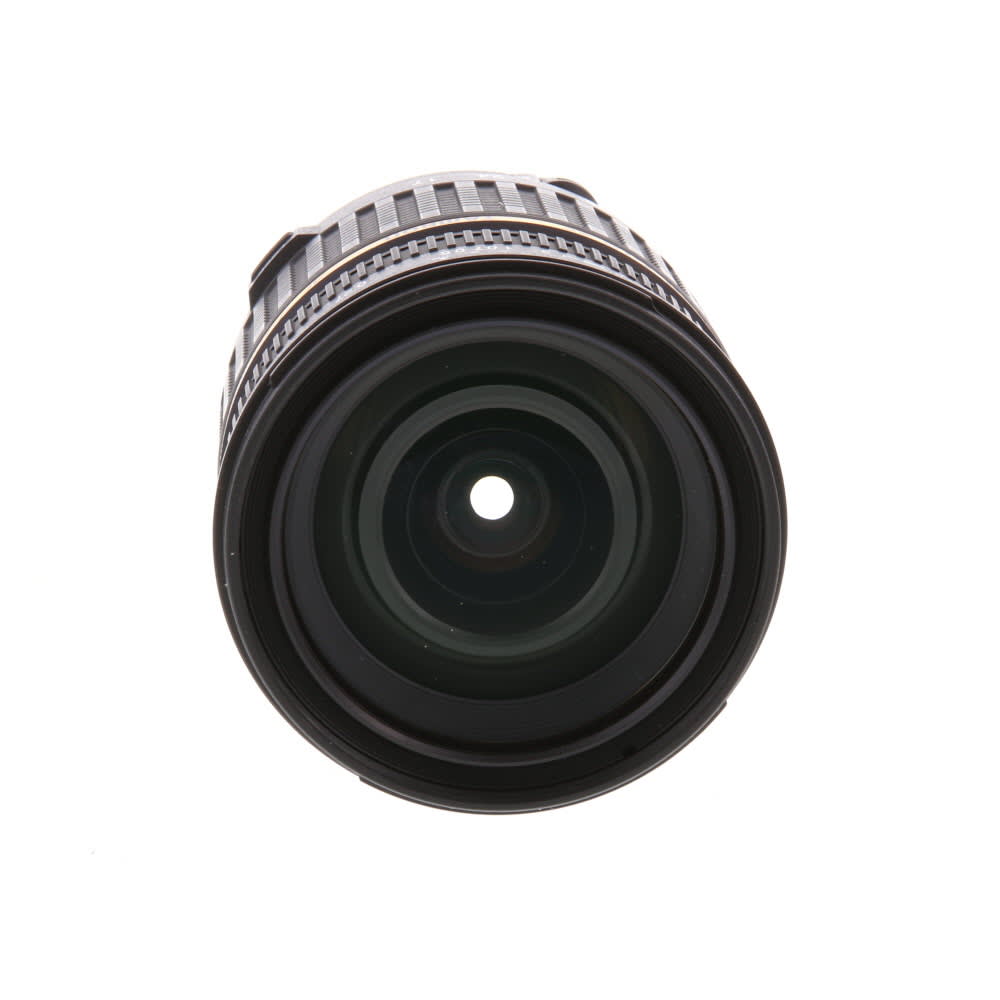
[IMAGE:tamron-b005-af-17-50mm-f2.8-sp-xr-di-ii-vc-ld-asph-if-lens]
Not all of this glass depreciates at the same rate. Two lenses can share a focal range and a maximum aperture and still land in completely different places on the resale curve. The specs tell you which is which.
GearFocus GearMaster data on the Tamron B005 17-50mm f/2.8 SP XR Di II VC lists optical image stabilization, a constant f/2.8 across the full range, a 72mm filter thread, and 570g of weight. The stabilization is the resale anchor. Older APS-C DSLR bodies almost never had in-body stabilization, so the lens had to provide it.
Compare that to the Tamron A16 17-50mm f/2.8 XR Di II. GearMaster data lists stabilization as None, a 67mm filter thread, and 430g. Lighter, yes. But on a stabilization-free DSLR body, that’s a real handheld penalty in dim rooms.
| Spec | Tamron B005 17-50mm f/2.8 | Tamron A16 17-50mm f/2.8 |
|---|---|---|
| Max aperture | f/2.8 constant | f/2.8 constant |
| Focal range | 17-50mm | 17-50mm |
| Image stabilization | Optical | None |
| Weight | 570g | 430g |
| Filter thread | 72mm | 67mm |
| Mounts | Canon EF, Nikon F | Nikon F |
| Format | APS-C / DX | APS-C / DX |
Among used APS-C kit lenses, that stabilization row is worth more than the weight row to most buyers. The B005 has a functional argument the new 16-50mm can’t erase for DSLR owners. The A16 is fighting on price alone, and price alone is a losing fight when a new lens shows up at $549.
Both lenses come up on GearFocus regularly, and both are worth a look if a DSLR is what you actually own.
The Mount Problem Nobody Wants to Talk About
Here’s the uncomfortable truth about a large share of used APS-C kit lenses on the market right now: they’re built for mounts that are no longer receiving new bodies.
GearMaster data on both of those Tamrons lists Canon EF and Nikon F mounts and an APS-C-only image circle. Two limitations stacked. The lens won’t cover a full-frame sensor, and the mount belongs to a DSLR line that’s winding down. A buyer purchasing into that today is buying into a closed system on purpose, usually because the body is already in the bag.
That’s not a death sentence. Plenty of excellent work still comes off crop-sensor DSLRs, and these lenses are genuinely good. But it does mean the pool of buyers for DSLR-mount used APS-C kit lenses shrinks a little every quarter, and new mirrorless-mount alternatives don’t feed back into that pool at all.
I made this mistake personally. Years ago I held onto a crop-only zoom because I’d convinced myself I’d shoot it again on a backup body. I never did. By the time I listed it, the market had moved past it and I took a worse price than I would have gotten the previous spring. Holding gear out of sentiment is expensive. I’d rather admit that than pretend I’m above it.
Our ultimate buying guide for used lenses digs further into which categories hold value and which quietly bleed out. Mount-limited glass sits squarely in the second group.
How Much Are Used APS-C Kit Lenses Really Worth Now?
I’m not going to invent a number for you. Nobody should, least of all a site that sells this gear. Prices on used APS-C kit lenses vary by mount, condition, and whether the original hood and caps are in the box, and anyone quoting a single universal figure is guessing.
What I can tell you is how the market usually behaves after an announcement like this. The pattern is consistent enough to plan around.
- Announcement week: Almost nothing moves. Listings sit. Sellers who follow news get nervous and a few undercut early.
- First reviews ship: This is when sentiment hardens. If the 16-50mm reviews well optically, the ceiling on comparable used APS-C kit lenses settles lower and stays there.
- Three to six months out: Supply of used copies increases as upgraders sell. More inventory, softer prices.
- The floor: Lenses with a specific functional advantage, like the B005’s stabilization on unstabilized bodies, stop falling sooner than the ones without.
Timing advice worth something: we’re in late October 2026. Gift season tightens supply on anything that reads as a good present, which includes affordable fast zooms. Used APS-C kit lenses often firm up slightly through November and December, then soften again in January when the new-gear gifts get unwrapped and the old gear gets listed.
Should You Sell Your Used APS-C Kit Lenses Right Now?
Sell if you’re not shooting it. That’s the whole test. A lens sitting in a drawer is depreciating with no offsetting benefit, and the next twelve months are not going to be kind to idle crop-sensor glass.
Sell now rather than in January if you can. Pre-holiday demand plus pre-review uncertainty is a decent window for used APS-C kit lenses. Once the first batch of real-world 16-50mm samples circulates, the comparison gets a lot more concrete and a lot less favorable to older copies.
Hold if the lens is doing active work on a body you still love. Nothing about a new announcement makes your existing glass optically worse. A 17-50mm f/2.8 that shoots beautiful portraits today will shoot beautiful portraits next year. Resale value is only relevant on the day you sell.
If you do sell, GearFocus takes an 8.5% total fee, which leaves 91.5% of the sale price with you. On gear in this price band, that margin is the difference between a sale worth making and one that isn’t. Listing is straightforward at gearfocus.com/sell, and buyers are actively searching for fast crop-sensor zooms right now.
A note on condition honesty. Our guide to pricing lenses for maximum value makes the point better than I will, but it bears repeating: describe the haze, the dust, the sticky zoom ring. The standard GearFocus policy gives buyers a 48-hour verification window after delivery, and if an item isn’t as described, the return costs them nothing and the seller covers return shipping. Accurate listings are cheaper than optimistic ones.
Buying Strategy for Used APS-C Kit Lenses in Late 2026
If you’re on the buying side, this announcement is straightforwardly good news. Your leverage improved and you didn’t have to do anything.
The practical question is whether to buy used at all or just get the new Tamron. The answer depends entirely on your mount. If you shoot a current mirrorless APS-C body that the 16-50mm covers, buying a used DSLR-mount zoom plus an adapter to save $150 is a bad trade. You’d be paying for slower autofocus and an extra point of failure.
If you shoot a Canon EF or Nikon F crop body, the new lens is irrelevant to you and the used market just got friendlier. That’s the best position to be in. Used APS-C kit lenses in your mount are about to face softer demand from people who are migrating away, and you’re not migrating.
Some practical buying rules I’d apply to used APS-C kit lenses specifically:
- Prioritize stabilization on unstabilized bodies. The B005’s optical stabilization versus the A16’s lack of it is a real shooting difference, not a spec-sheet difference.
- Check the filter thread against your existing filters. 72mm versus 67mm is a genuine cost difference if you own polarizers.
- Weigh the weight. 570g versus 430g sounds trivial until hour six of a wedding reception.
- Don’t pay a premium for boxes. Original packaging on a decade-old third-party zoom adds nothing to image quality and shouldn’t add much to price.
- Buy the condition tier you can actually live with. Cosmetic wear on used APS-C kit lenses is largely irrelevant; optical condition is everything.
One more thing I got wrong early on, and I’ll own it: I used to filter for the newest version of any lens by default, assuming newer meant better. For used APS-C kit lenses that’s often false. The older A16 and the newer B005 share the same optical formula family, and which one serves you better depends on whether your body stabilizes. Newer isn’t a feature. Fit is.
If your plans include eventually moving to full frame, the calculus shifts again. Crop-only glass doesn’t come with you. In that case, it may be worth reading up on used Canon RF lenses under $1,000 before sinking money into another APS-C-only purchase. And for ultra-wide coverage on a DSLR, the Tamron SP AF 11-18mm Di II occupies a niche the 16-50mm doesn’t touch at all.
BOTTOM LINE
- Price ceiling, not price collapse: The sub-$550 Tamron caps what used APS-C kit lenses can ask, especially in the $300-$450 band. Older copies don’t become worthless; they become harder to overprice.
- Stabilized copies hold better: GearMaster data gives the B005 optical stabilization at 570g versus none on the 430g A16. That one spec is the clearest resale divider.
- DSLR mounts face a shrinking buyer pool: Canon EF and Nikon F crop glass serves existing owners well but attracts fewer new buyers each quarter.
- Sell idle gear before January: Pre-holiday demand plus pre-review uncertainty is the better selling window for used APS-C kit lenses this year.
- Buy if your mount is already set: Canon EF and Nikon F crop shooters get softer prices with no downside. Mirrorless APS-C owners should probably just buy the new lens.
None of this is a reason to panic-sell. It’s a reason to make a decision instead of drifting. Fast crop-sensor glass is in a genuinely interesting spot right now: the new stuff is cheaper than it’s ever been, and the secondhand stuff is about to get cheaper too. Both of those are wins for anyone who just wants to shoot. Figure out which side of the trade you’re on, then act in the next few weeks rather than the next few months. Used APS-C kit lenses come up on GearFocus constantly, and if you’ve got one gathering dust, somebody out there is searching for exactly that mount right now.
FAQ
Will the Tamron 16-50mm F2.8 crash prices on used APS-C kit lenses?
No crash, but a ceiling. A sub-$550 new lens with a warranty makes it hard for secondhand fast zooms to hold $400-plus asking prices. Expect gradual softening over several months rather than an overnight drop.
Are used APS-C kit lenses still worth buying in 2026?
Yes, if you own a Canon EF or Nikon F crop body. The new Tamron doesn’t fit those mounts, so your used options stay relevant and get cheaper. Mirrorless APS-C owners should compare against the new lens directly.
Which matters more on used APS-C kit lenses, stabilization or weight?
Stabilization, usually. GearMaster data shows the B005 at 570g with optical stabilization and the A16 at 430g without it. On unstabilized DSLR bodies, that stabilization buys real handheld shutter speed in low light.
Should I sell my APS-C lens now or wait until next year?
Now, if you aren’t actively shooting it. Pre-holiday demand is firmer and the new Tamron’s reviews haven’t landed yet. January typically brings more listings and softer prices as upgraders clear out older glass.
Own one like this?
Make room for new gear in minutes.
