- Buyer protection on every order
Sony A7 III Buying Guide: Why This Used Camera Still Lasts Forever
Bill Pryor
Sep 11, 2026
KEY TAKEAWAYS
- The short answer: This sony a7 iii buying guide says buy it. The Sony A7 III is a 24.2MP full-frame body with 693 phase-detect points, dual card slots, and roughly 610 CIPA shots per charge, and used supply is climbing as owners move to the A7 IV. Strong value in September 2026.
- Supply is your friend: More A7 III bodies on the used market means more negotiating room and more condition tiers to choose from.
- Check the shutter, not the paint: The A7 III is rated to roughly 200,000 shutter actuations. Cosmetic wear matters far less than count and sensor condition.
- Best suited to: Hybrid shooters, event and portrait photographers, and anyone who wants full-frame autofocus without paying current-generation prices.
- Consider passing if: You need 4K/60, 10-bit internal, or a fully articulating screen. Those are A7 IV features, not A7 III features.
The box came taped with the kind of care that tells you something. Bubble wrap, then a plastic bag, then the original Sony carton inside, soft at the corners from eight years of sitting on a shelf. Cold plastic in the hand. Battery at 40%. The little chirp of the shutter waking up, and then the number on the screen that decides everything: shutter count, low four figures.
Somebody bought a mirrorless camera in 2018, shot their kid’s birthdays with it, and upgraded. That’s the whole story. And that story is repeating itself thousands of times right now.
Which brings us to why this sony a7 iii buying guide exists in September 2026. Jason Vong’s late-August video called the A7 III the perfect mid-life camera, the one that’ll last forever, and predicted a wave of these bodies hitting the used market as owners trade up to the A7 IV. He’s right about the wave. This guide is about what to do with it.
Why a Sony A7 III Buying Guide Makes Sense Right Now
Here’s the deal with generational churn on the used market: it doesn’t happen when a camera launches. It happens two or three years later, when the successor’s price finally softens enough that mainstream owners pull the trigger.
The A7 IV arrived in late 2021. Now, five years on, its used price has come down far enough that the A7 III crowd is finally upgrading in volume. Every one of those upgrades puts a body on the market. That’s the mechanic behind this sony a7 iii buying guide: you’re shopping into rising supply, not shrinking supply.
Rising supply does two things for a buyer. It pushes asking prices down, and it widens the condition spread. When only a handful of bodies are listed, you take what’s there. When plenty are listed, you can hold out for the low-count, boxed, one-owner example and skip the beaten rental unit.
Timing note for anyone reading this in early September: gifting season tightens used supply every year. Listings that sit unsold through October often move fast in late November. If you’re shopping, the next eight weeks are more comfortable than the eight after that.
What the Sony A7 III Actually Is
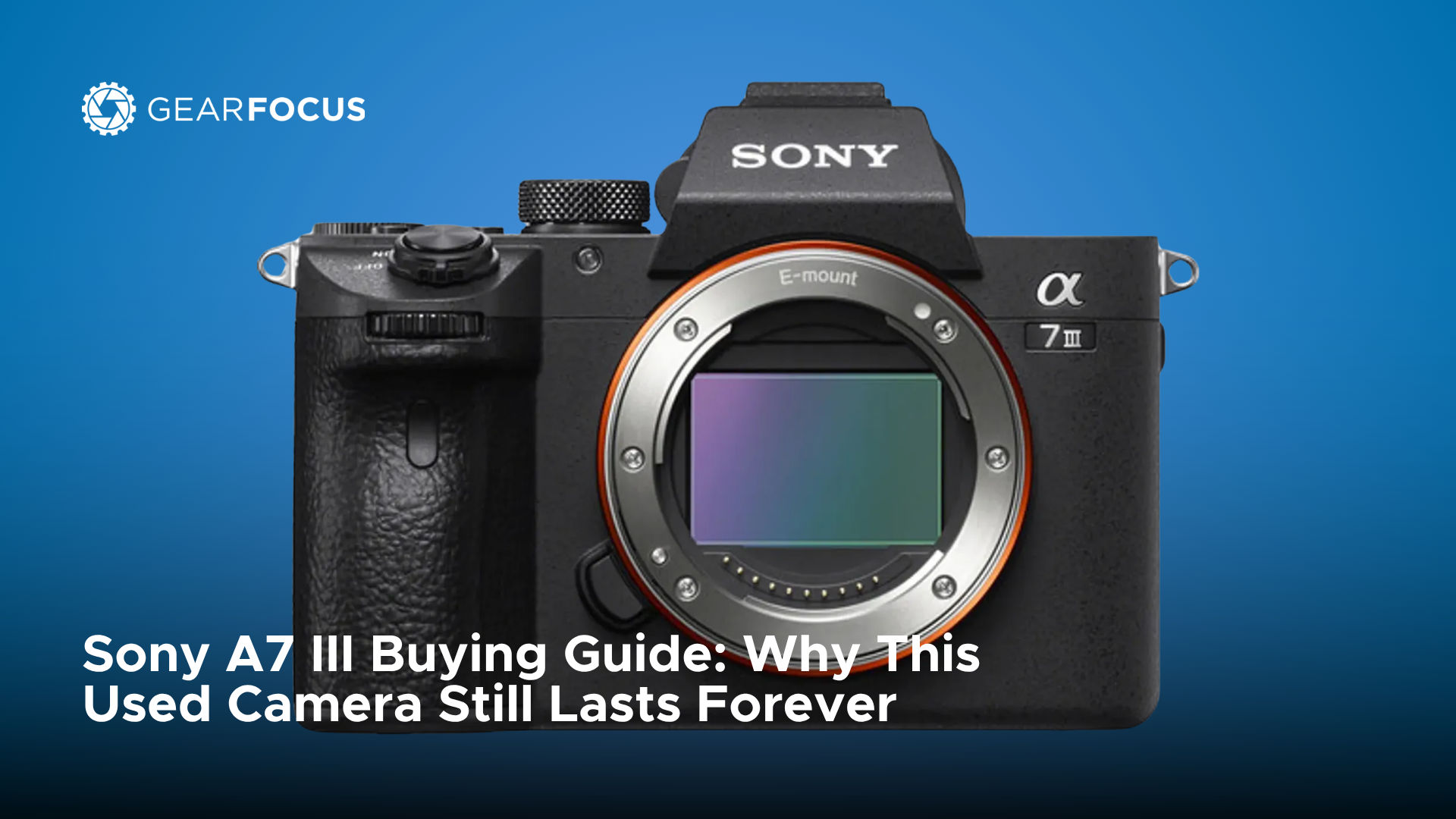
Full name first, since this matters for anyone comparing spec sheets: the Sony Alpha A7 III, model ILCE-7M3, released in early 2018.
It’s a 24.2-megapixel back-illuminated full-frame sensor paired with the BIONZ X processor. Hybrid autofocus with 693 phase-detection points covering roughly 93% of the frame, plus 425 contrast-detection points. Ten frames per second with continuous autofocus and exposure tracking. Five-axis in-body stabilization rated at 5 stops. Dual SD slots, one of them UHS-II.
Video is 4K up to 30p, oversampled from the full sensor width at 24p, with S-Log2 and S-Log3 profiles and 8-bit internal recording. Battery life is the sleeper spec: roughly 610 shots per charge using the NP-FZ100, which was a genuine leap over the older FW50 bodies and still holds up against plenty of current cameras.
Nothing in that list is flashy in 2026. Everything in that list is enough. That gap between “not flashy” and “enough” is the entire investment thesis of this sony a7 iii buying guide.
How Much Should You Pay? A Sony A7 III Buying Guide to Condition Tiers
GearFocus publishes verified sales data for this body, and the pricing breakdown lives in our 2026 Sony A7 III pricing guide. Read that alongside this sony a7 iii buying guide before you make an offer, because real transaction data beats any asking price you’ll see in a listing.
What this sony a7 iii buying guide can tell you is how to read a listing’s condition against what you’re paying. Here’s the framework:
| Condition | What it usually means | What to verify |
|---|---|---|
| Like New / Mint | Boxed, all accessories, minimal use, often under 10,000 actuations | Shutter count screenshot, box serial matches body serial |
| Excellent | Light finish wear, fully functional, typically 10,000-50,000 actuations | Shutter count, sensor photos, dust in EVF |
| Good | Visible brassing, grip wear, 50,000-100,000 actuations | Rear dial and rubber grip condition, card door hinge |
| Fair | Heavy use, possible ex-rental, above 100,000 actuations | Shutter count, service history, dead pixels |
| Poor / As-Is | Known faults or unverified function | Final sale on GearFocus. No returns. Buy only if you can repair it. |
The tier that offers the most value in this sony a7 iii buying guide is Excellent. A body with 30,000 actuations has used 15% of its rated life and typically sells for meaningfully less than a mint example. You’re paying for use, not for abuse.
Used A7 III bodies come up on GearFocus regularly, and with the upgrade wave underway, listings across every one of those tiers are easy to find. Worth a browse before you commit to the first one you see.
The Shutter Count Conversation
I ignored the actuation count on my first used body. Rookie mistake, and an expensive one. It gave out eight months later, in the middle of a job, and the repair quote made the original purchase look silly.
So: the A7 III’s mechanical shutter is rated to approximately 200,000 actuations. That’s a design target, not a cliff. Plenty of bodies run past it, and a few fail before it. What the number tells you is where you are in the curve.
Some quick math, since this is the part of the sony a7 iii buying guide that saves people money. A wedding photographer might fire 3,000 frames in a weekend. A hobbyist shooting family and travel might do 3,000 in a year. Same number, two completely different lifespans behind it.
Ask the seller for a shutter count screenshot. Free tools read it out of the EXIF data, and any seller who’s done this before will have the number ready. A seller who won’t provide it isn’t automatically hiding something, but they’ve given you a reason to lower your offer.
One more wrinkle worth knowing: the A7 III also has a fully electronic shutter option for silent shooting, which doesn’t touch the mechanical count. A body used heavily in silent mode can have a lower count than its real usage suggests. Check the sensor photos too.
Is the Sony A7 III Still Worth Buying in 2026?
Yes, and the reasoning is boring in the best way.
The A7 III’s autofocus system tracks moving subjects reliably in low light and holds faces and eyes through frame-to-frame movement. Eye AF works in continuous mode for stills. That capability was the headline feature in 2018 and it hasn’t degraded since. Autofocus doesn’t wear out.
The 24.2MP sensor delivers roughly 14 stops of dynamic range in raw at base ISO, with usable files well into the five-figure ISO range. For prints, client galleries, editorial work, and anything destined for a screen, 24 megapixels remains plenty. The pixel-count arms race stopped mattering to most working shooters somewhere around 2019.
The dual card slots are the quiet argument this sony a7 iii buying guide keeps coming back to. Redundant recording on a paid job isn’t a luxury feature. Cameras at this price point with two slots are still not universal.
And the E-mount lens ecosystem has grown enormously since 2018. Sigma, Tamron, and Samyang all build for it, which means the cheapest path to a fast full-frame prime in 2026 runs straight through this body’s mount.
What the Sony A7 III Buying Guide Says About Its Limits
Fair is fair. Here’s where the camera shows its age, stated plainly.
- Video is 8-bit internal, 4K/30 maximum. No 4K/60, no 10-bit 4:2:2 without an external recorder. Heavy color graders will feel this.
- The rear screen tilts, it doesn’t articulate. Solo video shooters and vloggers who need to monitor themselves will find this genuinely limiting.
- The menu system is the pre-2020 Sony menu. Deep, unintuitive, and famously frustrating. Custom buttons and My Menu fix most of it, but the first week is a chore.
- 2.36-million-dot EVF. Perfectly usable, visibly behind current-generation viewfinders when compared side by side.
- Single UHS-II slot. Slot two is UHS-I, which slows sustained burst writing when you’re recording to both.
- No 10-bit HLG, limited 4K crop options. Fine for delivery-ready footage, thin for heavy post work.
None of those are dealbreakers for stills-first shooters. Two of them are dealbreakers for video-first shooters. Know which one you are before you read the rest of this sony a7 iii buying guide as a green light.
Sony A7 III or A7 IV? The Upgrade Math
This is the question the whole upgrade wave is built on, and it deserves a straight answer rather than a hedge.
The A7 IV brings 33 megapixels, 4K/60 in Super35 crop, 10-bit 4:2:2 internal, a fully articulating screen, the redesigned menu system, and a CFexpress Type A slot. It is a better camera. It is also a more expensive camera on the used market, and the price gap between the two is wide enough to buy a very good lens.
Our full head-to-head breaks down the specifics: Sony A7 IV vs A7 III on the used market. And with the A7 V now in the picture, the pricing relationship between all three has shifted, which we cover in the post-A7 V market analysis.
The recommendation from this sony a7 iii buying guide: if you shoot mostly stills, take the A7 III and spend the difference on glass. A fast prime transforms your images more than nine extra megapixels will. If video is half your work or more, the A7 IV’s 10-bit pipeline justifies the premium.
A Practical Sony A7 III Buying Guide Checklist
Walk through this before money changes hands. It takes ten minutes and it’s the most useful part of any sony a7 iii buying guide.
- Shutter count screenshot. Non-negotiable. Ask for it in writing before you offer.
- Sensor photos at f/16. Dust is normal and cleanable. Scratches and oil are not.
- Both card slots tested. Ask the seller to confirm each slot writes independently.
- Battery health. The NP-FZ100 degrades. Budget for a spare regardless, since they’re inexpensive used.
- Grip rubber and rear dial. Peeling rubber is cosmetic. A sticky rear dial suggests hard use.
- Firmware version. Late A7 III firmware improved animal Eye AF and general stability. Free to update, worth confirming.
- Serial number match. Body serial should match the box label if the box is included.
- Original accessories. Charger, strap, cap, and the FZ100 battery. Missing accessories are fair negotiating leverage.
The other thing I got wrong early on: I assumed a low price signaled a problem. Sometimes it just signals a seller who wants the money this week. Ask questions instead of assuming.
Buying Protection and What Happens After You Click
On GearFocus, every purchase carries a 48-hour verification window after delivery. If the camera isn’t as described, you return it at no charge and the seller covers return shipping. That window is exactly what the checklist above is for. Unbox it, run the checks, decide.
Some sellers additionally offer a 14-day no-questions-asked return policy. It isn’t platform-wide, so check the individual listing. Where it applies, items over $1,500 carry a 15% restocking fee, and Poor or As-Is items are excluded entirely.
Speaking of which: Poor and As-Is listings are final sale, no returns. A cheap A7 III in that tier is a project camera, not a working camera. Buy accordingly.
Most orders ship within one to three business days, and sellers on GearFocus have verified identities rather than just aged accounts. Sellers keep 91.5% of the sale price, which is part of why supply here holds up during upgrade cycles like this one.
Have an A7 III to Sell Instead?
Flip side of the same wave. If you’re the one upgrading to the A7 IV, the sony a7 iii buying guide logic runs in reverse: supply is rising, so listing quality is what separates a fast sale from a stale one. Clean photos, a shutter count in the description, and an honest condition grade do most of the work.
Our guide to selling a used Sony A7-series body covers pricing and listing specifics. And the seasonal read matters here too: listing in October ahead of gift season beats listing in January after it.
BOTTOM LINE
- Verdict: Buy. The Sony A7 III remains a capable full-frame hybrid body and the current upgrade wave is putting more of them on the market at better prices.
- Sweet spot: Excellent condition, 10,000 to 50,000 actuations, complete with box and accessories.
- Hard requirement: Shutter count screenshot before you offer. Every time.
- Buy it if: Stills lead your work, you want dual card slots, and you’d rather put the savings into a fast lens.
- Skip it if: You need 4K/60, 10-bit internal video, or a flip-out screen. Go A7 IV.
- Best window: September through October 2026, before gifting-season demand tightens used supply.
Final Word
Cameras stop being interesting long before they stop being good. The A7 III crossed that line around 2021 and has spent the five years since quietly earning its keep in a lot of camera bags, which is precisely the point Jason Vong makes in his review of the A7 III as a long-term mid-life camera.
The used market rewards patience and punishes urgency, and right now patience is cheap because supply is growing. Follow this sony a7 iii buying guide, check the count, run the checklist, and there’s a lot of camera waiting at the other end of it. Used A7 III bodies come up on GearFocus constantly, and browsing costs nothing.
FAQ
Is the Sony A7 III still worth buying used in 2026?
Yes. Its 693-point autofocus, 24.2MP full-frame sensor, dual card slots, and 5-axis stabilization remain competitive for stills work, and rising used supply from A7 IV upgraders is improving prices for buyers.
What shutter count is too high for a used Sony A7 III?
The mechanical shutter is rated to roughly 200,000 actuations. Under 50,000 is comfortable. Above 100,000 isn’t automatically a pass, but it should be reflected in a lower price.
Should I buy the A7 III or spend more on the A7 IV?
Stills-first shooters should take the A7 III and put the savings toward lenses. Video-first shooters should pay up for the A7 IV’s 10-bit 4:2:2 internal recording and articulating screen.
Does the Sony A7 III shoot good enough video for paid client work?
It handles 4K up to 30p in 8-bit with S-Log3 profiles, which is fine for delivery-ready footage and corporate or event work. Heavy color grading benefits from 10-bit capture instead.
What accessories should come with a used A7 III?
An NP-FZ100 battery, charger or USB cable, body cap, and strap at minimum. Original box and paperwork add resale value. Missing items are legitimate negotiating leverage on price.
How long will a used Sony A7 III keep working?
A body bought at 30,000 actuations has roughly 85% of its rated shutter life remaining. With normal hobbyist use, that’s realistically a decade of shooting before shutter replacement becomes a question.
Own one like this?
Make room for new gear in minutes.
