- Buyer protection on every order
Best Used Full-Frame Mirrorless Cameras Worth Buying Right Now
Jake Bennett
Oct 12, 2026
KEY TAKEAWAYS
- The short answer: Previous-generation used full-frame mirrorless cameras from Sony, Canon, and Nikon now sit in the $800 to $1,400 range, according to DPReview. That buys a full-frame sensor, modern autofocus, and 4K video for roughly the price of a new enthusiast crop body.
- What drives the drop: Successor launches, not wear. A camera does not get worse when its replacement ships, but its resale price falls anyway.
- Canon’s entry point: The Canon EOS RP pairs a 26MP full-frame sensor with 4779 Dual Pixel AF points and eye tracking, in one of the smallest full-frame bodies ever made.
- The specialist play: The Sigma fp L brings a 61MP sensor and 12-bit video output in a 427g aluminum body, for shooters who want resolution over convenience.
- The catch: Most bodies in this tier skip in-body stabilization and run short on battery life. Budget for extra cells and stabilized glass.
DPReview now puts previous-generation Sony, Canon, and Nikon bodies in the $800 to $1,400 used bracket. That is the headline: used full-frame mirrorless cameras have quietly become the cheapest serious sensor in photography. Not entry-level cheap. Full-frame cheap.
Sit with that for a second. A sensor format that cost $2,500 to $3,500 at launch, in bodies that still shoot professional work every weekend, now trades for less than a single fast prime lens.
Nothing about the hardware changed. The shutter fires at the same speed. The autofocus tracks the same eyes. What changed is that a Mark II came out, and the market did what the market always does.
What Used Full-Frame Mirrorless Cameras Actually Cost in 2026
The $800 to $1,400 window is the number worth anchoring to. Below it sit crop-sensor bodies and the oldest full-frame mirrorless attempts, the ones with contrast-detect autofocus that hunts in a dim reception hall. Above it, prices climb fast toward current-generation gear.
Inside that window, though, is a genuinely strange amount of camera. This is the tier where used full-frame mirrorless cameras stop being a compromise and start being a strategy.
Here is how the pricing tiers break down across the broader used market, based on the DPReview bracket and how condition typically moves value on any marketplace:
| Tier | Typical Used Range | What You Get |
|---|---|---|
| Entry full-frame (older, higher shutter counts) | $800 – $1,000 | Full-frame sensor, competent phase-detect AF, 4K with crop or frame-rate limits |
| Mid-tier previous-gen | $1,000 – $1,200 | Better burst rates, deeper buffers, stronger subject tracking |
| Top of the bracket | $1,200 – $1,400 | Near-current AF performance, dual card slots on some bodies, stronger video specs |
Condition moves you within those tiers more than anything else. A body with a low shutter count, original box, and a charger that still holds a charge sits at the top of its range. A well-traveled one with brassing on the grip sits at the bottom, and honestly, often shoots identically.
I ignored shutter count on the first used body I ever bought. Seemed like a spec sheet detail. It was not. That camera gave out eight months later, halfway through a shoot, and I spent the rest of the day borrowing a body from someone who had been smarter than me.
Why Prices on Used Full-Frame Mirrorless Cameras Fell This Far
Three forces stacked up at once.
Successor launches. This is the big one. When a Mark II arrives, early adopters sell the Mark I to fund it, and supply spikes within weeks. Prices soften before the new body has even shipped in volume.
Mount maturity. Sony’s E-mount, Canon’s RF mount, and Nikon’s Z mount are all deep enough now that a five-year-old body still has a full lens ecosystem behind it. Nobody is stranded. That removes the last real objection to buying a previous-generation body.
Spec-sheet saturation. The gap between a 2021 full-frame body and a 2026 one is real, but it is narrower than the gap between 2016 and 2021 was. Faster readout, better subject recognition, higher burst rates. Genuine improvements. Not the difference between a usable camera and an unusable one.
Add those together and you get the current landscape: used full-frame mirrorless cameras that were genuinely professional tools three years ago, priced like enthusiast gear today.
The Canon EOS RP: Full-Frame at Its Smallest
The Canon EOS RP is the most approachable door into used full-frame mirrorless cameras, and its spec list explains why it holds up.
Per GearFocus GearMaster data, the EOS RP runs a 26MP full-frame sensor behind Canon’s DIGIC 8 processor, with a native ISO range of 100 to 40000. Autofocus combines Dual Pixel AF with contrast detection across 4779 focus points, and both eye tracking and subject tracking are built in.
Four thousand seven hundred and seventy-nine focus points. On a body in this price tier. That number alone reframes what used full-frame mirrorless cameras mean for a portrait or event shooter working on a budget.
Stills top out at 6240×4160 pixels. Burst runs to 5 fps, which is honest rather than impressive. Around back, a Vari-Angle 3.0-inch LCD at 1.04 million dots swings out for low-angle and overhead work, and the 2.36 million-dot OLED viewfinder refreshes at 60Hz.
Strengths: Dense phase-detect autofocus coverage with eye and subject tracking. Genuinely compact full-frame body. Wide ISO latitude. Fully articulating rear screen.
Limitations: No in-body optical stabilization, only digital or electronic IS. 4K video caps at 25fps and 8-bit color. Battery life is rated around 250 shots per charge, which is low for the format.
That battery number deserves attention. Two hundred and fifty frames is a short afternoon. Anyone buying this body for event work should plan on three spares minimum, and the good news is those batteries are cheap and plentiful on the used market.
Best suited to travel shooters, portrait photographers, and anyone stepping up from crop sensor who wants the shallowest possible on-ramp to full-frame.
The Sigma fp L: Resolution Over Convenience
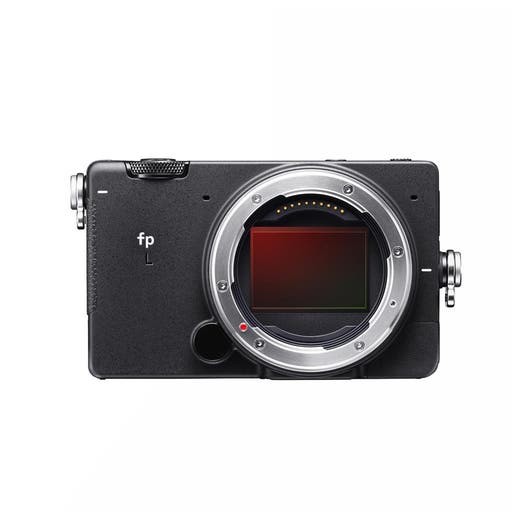
The Sigma fp L is the odd one out among used full-frame mirrorless cameras, and that is exactly the appeal.
GearFocus GearMaster data puts it at 61MP on a full-frame sensor, driven by the SIGMA TRUE III processor, inside an aluminum body measuring 112.6 x 69.9 x 45.3 mm and weighing 427g. It uses the L-Mount, takes SD/SDHC/SDXC cards, and runs a native ISO range of 100 to 25600.
Sixty-one megapixels in a body that weighs less than a can of soup. That is not a typical spec combination, and it is not a typical camera.
Video is where the fp L gets genuinely unusual for this price bracket. 4K capture reaches 120fps, and bit depth climbs to 12-bit for color grading work that most bodies in this range cannot touch. Fourteen color profiles ship for both stills and video, including Cinema, Teal and Orange, and Duotone.
Strengths: 61MP resolution for detail-critical stills. Up to 12-bit video output. 4K at up to 120fps. Deep in-camera color profile library.
Limitations: No built-in Wi-Fi or Bluetooth, so wireless transfer and remote control are off the table. No in-body optical stabilization, digital and electronic IS only. Battery life around 240 shots per charge.
This is a specialist tool, not a general-purpose body. Studio work, landscape, documentary, and travel where a tripod or gimbal is already in the bag. Consider it if resolution and color grading matter more to you than convenience features.
What You Give Up in This Price Range
Being straight about the tradeoffs is the only way this guide is worth anything.
Stabilization is the most common casualty. Both featured bodies skip in-body optical IS. That pushes the burden onto stabilized lenses or a tripod, and it changes your handheld shutter-speed math meaningfully.
Battery life runs short. Roughly 250 shots on the EOS RP, roughly 240 on the fp L. Current-generation bodies with larger cells routinely double that. Spares are the fix, and they are inexpensive.
Video specs carry asterisks. The EOS RP tops out at 25fps in 4K with 8-bit color. The fp L is far stronger here, but gives up wireless entirely. Read the fine print before you commit.
Burst rates are modest. 5 fps on the EOS RP is fine for portraits and adequate for slow-moving subjects. It is not a sports camera, and nobody should pretend otherwise.
None of these are dealbreakers. They are the reason the price is what it is. Used full-frame mirrorless cameras in this bracket earn their discount by asking you to work around two or three specific gaps.
Who Should Buy Used Full-Frame Mirrorless Cameras Right Now
The crop-sensor upgrader. If you have been shooting APS-C and want shallower depth of field and cleaner high-ISO files, this bracket is the least painful jump that has ever existed. Our roundup of the best used full-frame cameras under $1,500 covers more options in adjacent price territory.
The second-body buyer. Wedding and event shooters need backup. Buying a previous-generation body as the backup is far smarter than buying a current one, and the wedding-focused used body guide goes deeper on that logic.
The tight-budget starter. If $1,000 is the ceiling, used full-frame mirrorless cameras get you further than new gear at the same price. The under-$1,000 used mirrorless guide maps that territory specifically.
The specialist. Resolution obsessives, color graders, gimbal shooters. The fp L exists for you.
Who Should Skip This Tier
Action and wildlife shooters who need 15 fps and deep buffers. Run-and-gun video shooters who cannot work without in-body stabilization. Anyone whose workflow genuinely depends on fast wireless transfer, which rules out the fp L immediately.
And anyone who will spend the next two years wondering about the newer model. That itch does not respond to savings. Buy the thing you will stop thinking about.
Timing Your Purchase This Fall

It is late September 2026, and the calendar matters here.
Used supply typically runs generous in autumn as sellers clear gear before the holidays. Then it tightens through late November and December, when gift buyers compete for the same bodies and listings move faster.
If you are buying, the weeks before Black Friday are usually more comfortable than the weeks during it. If you are selling, the opposite is true: demand for used full-frame mirrorless cameras firms up as gifting season approaches, and a clean, well-photographed listing does better work in December than it does in September.
Successor timing matters too. Used prices soften predictably in the months after a replacement model ships, which is precisely the mechanism that created this $800 to $1,400 bracket in the first place.
Buying Safely on the Used Market
Three things to check before money moves.
Shutter count. Ask for it. A seller who will not provide it is telling you something. For mirrorless bodies the number matters less than it did on DSLRs, but it still tells you how the camera has lived.
Sensor condition. Request a photo of a plain white wall at f/16. Dust shows up clearly. Dust is cleanable. Scratches are not.
What is actually included. Battery, charger, body cap, strap. Missing accessories are negotiable, but a missing charger costs real money to replace.
On GearFocus, every seller identity is verified before they can list, and the standard buyer protection gives you 48 hours after delivery to confirm the gear matches its description. If it does not, the return costs you nothing and the seller covers return shipping. Some sellers additionally offer a 14-day no-questions-asked window, though that is seller-specific rather than platform-wide.
Sellers keep 91.5% of the sale price, which is a meaningful margin advantage over generalist marketplaces and part of why photography-specific inventory keeps landing here rather than somewhere general.
How Long Will This Window Last?
Honest answer: nobody knows, and anyone who claims otherwise is guessing.
What is predictable is the mechanism. Each new generation pushes the previous one down a tier. Today’s $2,000 body becomes next cycle’s $1,300 body. The $800 to $1,400 bracket does not disappear, it just gets populated by newer hardware.
Which means there is no urgency, and I am not going to manufacture any. If your work needs full-frame now, the current crop of used full-frame mirrorless cameras is an excellent answer. If it does not, waiting costs you nothing but time. For a wider view of what has been moving lately, the hottest used cameras of the last year is a useful read.
BOTTOM LINE
- The bracket: $800 to $1,400 for previous-generation Sony, Canon, and Nikon full-frame bodies, per DPReview.
- Canon EOS RP: 26MP, DIGIC 8, 4779 Dual Pixel AF points with eye tracking, ISO 100–40000, Vari-Angle screen. No IBIS, 4K capped at 25fps, ~250 shots per charge.
- Sigma fp L: 61MP, 427g aluminum body, 4K up to 120fps, 12-bit output, 14 color profiles. No wireless, no IBIS, ~240 shots per charge.
- Universal tradeoffs: Expect no in-body stabilization and short battery life. Budget for spares and stabilized glass.
- Buy if: You are upgrading from crop, adding a backup body, or working to a hard budget ceiling.
- Skip if: You need high burst rates, in-body stabilization, or fast wireless transfer.
- Verify before buying: Shutter count, sensor photo at f/16, and exactly what accessories are included.
Here is the part that took me embarrassingly long to internalize: gear anxiety is expensive, and nobody has ever looked at a good photograph and asked which generation of body shot it. The $800 to $1,400 bracket of used full-frame mirrorless cameras exists because manufacturers need to sell new cameras, not because the old ones stopped working.
Bodies in this range come up on GearFocus regularly, and both the EOS RP and the fp L are worth a look if either fits how you actually shoot. Whichever direction you go, used full-frame mirrorless cameras remain the single best value in photography right now, and the gap between what these cost and what they deliver is wider than it has been in years.
FAQ
Are used full-frame mirrorless cameras still worth buying in 2026?
Yes. Previous-generation bodies now sell for $800 to $1,400 while delivering full-frame sensors, phase-detect autofocus, and 4K video. The performance gap versus current models is real but far narrower than the price gap.
What is the biggest compromise at this price point?
In-body image stabilization. Both the Canon EOS RP and Sigma fp L offer only digital or electronic IS, so you will rely on stabilized lenses or a tripod for slower handheld shutter speeds.
How many shutter actuations is too many on a used mirrorless body?
Mirrorless bodies handle high counts better than DSLRs did, but always request the figure. It tells you how hard the camera has worked, which informs your price expectations more than it predicts failure.
Is the Canon EOS RP good enough for paid work?
For portraits, travel, and lifestyle work, yes. Its 26MP sensor and 4779 autofocus points handle those jobs well. Fast action is harder, since burst tops out at 5 fps and battery life runs near 250 shots.
Should I buy now or wait for holiday deals?
Autumn generally offers better selection than December, when gift-season demand tightens supply on used bodies. There is no dramatic seasonal price crash on used gear, so buy when your work needs it.
Photo: Sinan KRIYA
Own one like this?
Make room for new gear in minutes.
