Nikon Nikkor AI-S 50mm f/1.8 Series E Lens
The Nikon Nikkor AI-S 50mm f/1.8 is a camera gear from Nikon — known for its 50mm f/1.8 Double Gauss and Nikon F Mount, Mirrorless Adaptable. Check GearFocus for current availability, with buyer protection on every purchase.
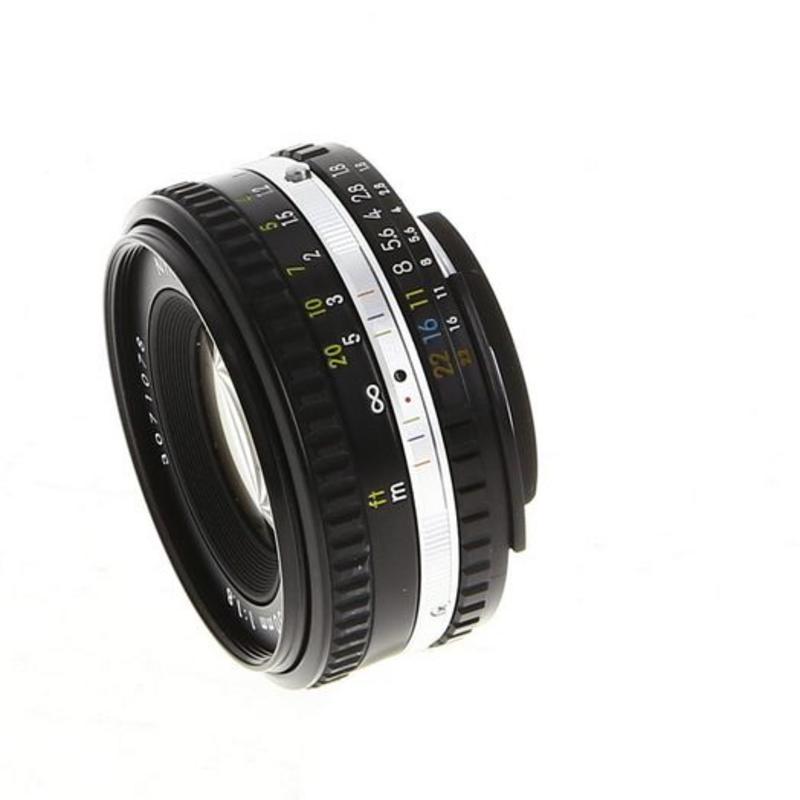
Nikon Nikkor AI-S 50mm f/1.8 Series E Lens
Get notified when one lists.
We'll text or email you the moment a Nikon Nikkor AI-S 50mm f/1.8 Series E Lens is listed on GearFocus.
Have a Nikon Nikkor AI-S 50mm f/1.8 sitting in your bag?
You'd be the first listing for this model.
Serious buyers are already watching — list yours in minutes.
Available Now on GearFocus


Nikon F2 Photomic Chrome Film SLR + Nikkor 105mm f/2.5 - 50mm f/1.4 - 35mm f/2.8


![[MINT-] Nikon F-801s (N8008s) 35mm SLR Film Camera Body - Tested & Clean](https://gearfocus.b-cdn.net/onEV8l520nVlioyJOCz0V53bOle2/products/BQh6CPGtXC4Hnek8lkAN/thumb@500_1790977206465.jpeg?width=600&quality=80&format=webp)
![[PATINA BEAUTY] Vintage Nikon EL (Nikkormat) 35mm SLR Body + 2x Lenses (28mm f/2.8 & Vivitar Series 1 28-90mm)](https://gearfocus.b-cdn.net/onEV8l520nVlioyJOCz0V53bOle2/products/Ufji0YSx8jEQeST3vb5g/thumb@500_1790972580083.jpeg?width=600&quality=80&format=webp)
[PATINA BEAUTY] Vintage Nikon EL (Nikkormat) 35mm SLR Body + 2x Lenses (28mm f/2.8 & Vivitar Series 1 28-90mm)


Overview — Nikon Nikkor AI-S 50mm f/1.8
Key Features — Nikon Nikkor AI-S 50mm f/1.8
50mm f/1.8 Double Gauss: A classic double gauss optical formula with 6 elements in 5 groups delivers a true standard field of view (46° diagonal) on Nikon F mount cameras.
Nikon F Mount, Mirrorless Adaptable: The Nikon F mount with no electronic contacts makes this lens straightforwardly adaptable to modern mirrorless systems like Sony E and Nikon Z with a simple passive adapter.
Ultra-Compact Build: At just 28mm long and 156g without caps, this lens is unusually small for a 50mm f/1.8, making it practical for everyday carry and adapted mirrorless use.
Aperture Ring with Click Stops: A full-stop click aperture ring with equidistant spacing allows precise, tactile exposure control without relying on camera electronics.
Depth-of-Field Scale: Engraved DOF scale and aperture markings support zone focusing and hyperfocal shooting, useful for street and film photography workflows.
14-Pointed Sunstars: Seven straight aperture blades produce well-defined 14-pointed sunstars from f/5.6 through f/22 when bright point light sources are in the frame.
Specifications — Nikon Nikkor AI-S 50mm f/1.8
| Spec | Detail |
|---|---|
| Lens name | Nikon 50mm 1.8 Series E |
| Lens series | Series E |
| Lens year_released | 1979 |
| Lens focal_length_mm | 50 |
| Lens max_aperture | 1.8 |
| Lens min_aperture | 22 |
| Lens diameter_mm | 62 |
| Lens length_mm | 28 |
| Lens weight_g | 156 |
| Lens weight_notes | without caps |
| Lens filter_diameter_mm | 52 |
| Lens aperture_blades | 7 |
Description — Nikon Nikkor AI-S 50mm f/1.8
The Nikon 50mm f/1.8 Series E is a manual-focus prime lens released in 1979 on the Nikon F mount, built around a double gauss optical formula using 6 elements in 5 groups. With a maximum aperture of f/1.8 and a minimum of f/22, it covers a 46-degree diagonal field of view and focuses as close as 0.6m, achieving a maximum magnification of 1:9.3. Weighing just 156g (without caps) and measuring only 28mm in length with a 62mm diameter, this is a notably compact standard prime.
The 52mm filter thread is widely compatible with common accessories. The aperture ring features full-stop click stops at equidistant spacing, and the focus ring rotates 160 degrees from minimum focus distance to infinity using a unit focus design. The 7 straight aperture blades produce 14-pointed sunstars between f/5.6 and f/22.
Vignetting at f/1.8 measures 2.1 EV, dropping to 0.6 EV from f/4.0 onward. Approximately 2,200,000 units were produced across two versions, making this lens widely accessible on the used market starting around $60.
Pros — Nikon Nikkor AI-S 50mm f/1.8
- ✓Extremely compact build at just 28mm long and 156g without caps
- ✓Wide f/1.8 maximum aperture with a close focusing distance of 0.6m
- ✓Produces 14-pointed sunstars from f/5.6 to f/22 thanks to 7 straight aperture blades
Cons — Nikon Nikkor AI-S 50mm f/1.8
- ✗Flare resistance is poor — ghosting is an issue at f/1.8 and veiling flare occurs at f/11 with light sources near the edge of the frame
- ✗Longitudinal chromatic aberration is strong at f/1.8 and still present at f/4.0, with purple fringing following a similar pattern
- ✗Coma performance requires stopping down to f/5.6 for good results, with large artifacts at f/1.8
Videos — Nikon Nikkor AI-S 50mm f/1.8
Nikon 50mm f/1.8 Series E: SnapChick Retro Review — Leigh & Raymond Photography